

China to Impose Tax on Condoms as Birth Rate Continues to Decline

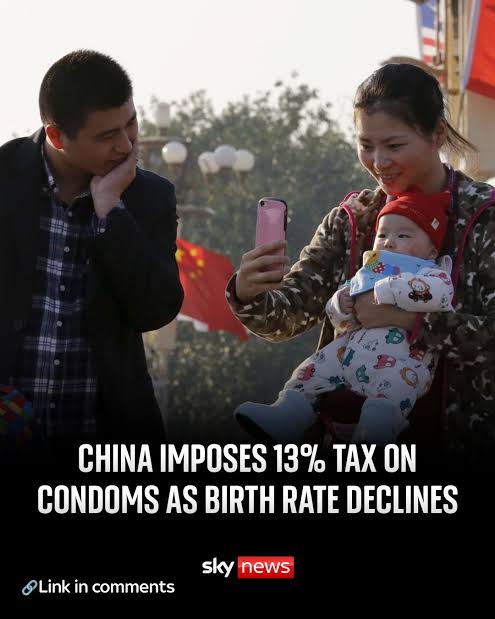
China is set to impose a tax on contraceptives for the first time in more than three decades as authorities intensify efforts to address the country’s declining birth rate.
Under the new tax laws, contraceptive drugs and products, including condoms, will no longer be exempt from the country’s 13 per cent value-added tax (VAT) from January 1, 2026.
The move comes amid a sharp fall in births. Data from China’s National Bureau of Statistics show that 9.5 million babies were born in 2024, down from 14.7 million in 2019. With deaths now outnumbering births, China lost its status as the world’s most populous country to India in 2023.
The policy shift has sparked widespread criticism and ridicule on Chinese social media, with many users arguing that the cost of raising a child far outweighs the price of contraceptives, even with added tax.
Hu Lingling, a mother of one, described the move as “ruthless,” saying she has no plans to have another child. “Compared to the forced abortions during the family planning era, this is also ironic,” she added.
Health experts have also raised concerns that higher costs for contraceptives could lead to an increase in unintended pregnancies and sexually transmitted diseases, particularly among low-income groups.
China previously enforced a strict one-child policy from around 1980 to 2015, using fines and other penalties. In some cases, women were subjected to forced abortions, while children born outside the policy were denied official identification.
The government relaxed the policy to allow two children per family in 2015 and later expanded it to three children in 2021 as population decline accelerated.
While contraception was once actively encouraged and often freely available, the new tax is expected to make such products more expensive in a bid to discourage their use.
Qian Cai, Director of the University of Virginia’s Demographics Research Group, said the tax would likely have a “very limited” impact on reproductive decisions. She warned that higher prices could reduce access to contraceptives among disadvantaged groups, potentially increasing unintended pregnancies and healthcare costs.
“For couples who do not want children, a 13 per cent tax on contraceptives is unlikely to outweigh the much higher costs of raising a child,” she said.
However, Yi Fuxian, a senior scientist at the University of Wisconsin–Madison, defended the move, calling it “logical.”
“China once controlled population growth, but now it is encouraging childbirth. Taxing these products simply treats them as ordinary commodities,” he said.
