

Myanmar holds first election since coup amid civil war, junta chief downplays presidency

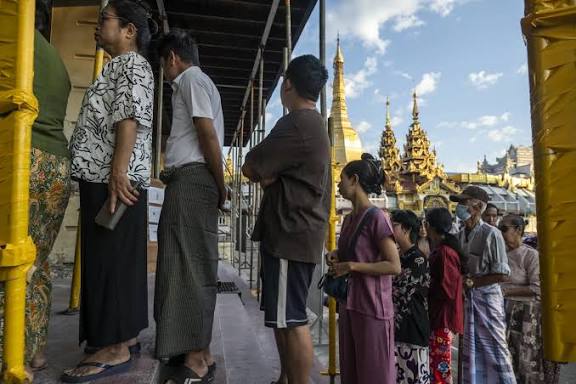
Myanmar began voting in a general election on Sunday, the first since the military seized power in 2021, amid an ongoing civil war and widespread doubts over the credibility of the process.
Polling opened at 6 a.m. as voters trickled into stations in major cities including Yangon and Mandalay, according to witnesses and local media. The vote is being held under the shadow of a nationwide conflict and amid criticism from the United Nations, Western governments and human rights groups, who say the exercise is neither free nor fair.
The ruling junta says the election offers a political and economic reset for the impoverished Southeast Asian nation. Critics, however, argue that opposition parties are effectively excluded and that the process is designed to entrench military rule.
Nobel Peace Prize laureate Aung San Suu Kyi, whose National League for Democracy (NLD) won a landslide victory in the last election in 2020, remains in detention. Her party has been dissolved following the coup.
Junta leader Min Aung Hlaing voted in the heavily guarded capital, Naypyidaw, dressed in civilian clothes. Photographs published by pro-military media showed him smiling and displaying an ink-stained finger, a mark used to prevent multiple voting.
Asked whether he intended to become president, a position analysts say he covets, Min Aung Hlaing played down his personal ambitions, noting that he does not lead a political party. “When parliament convenes, there is a process for electing the president,” he said.
Following the coup, mass protests were violently crushed by the military, pushing many opponents to take up arms and plunging the country into a prolonged conflict. Against that backdrop, the military-aligned Union Solidarity and Development Party (USDP) is widely seen as the frontrunner in the election.
The USDP, led by retired generals and fielding around one-fifth of all candidates, is expected to dominate the polls due to the absence of major opposition groups, said Lalita Hanwong, a Myanmar expert at Thailand’s Kasetsart University. She described the election as a mechanism to extend military control under a civilian façade.
Voting will take place in three phases, with additional rounds scheduled for January 11 and January 25, covering 265 of Myanmar’s 330 townships. However, the junta does not fully control all of these areas due to ongoing fighting. No dates have been announced for vote counting or the release of results.
UN human rights chief Volker Turk warned last week that the elections are being conducted in an environment marked by violence and repression. Residents in major cities reported little enthusiasm or campaign energy, although they said there was no overt coercion to force people to vote.
The junta has promoted the polls as a pathway out of the crisis, citing a 2010 military-backed election that led to limited political and economic reforms. Authorities say more than 50,000 electronic voting machines are being used nationwide to speed up counting and prevent fraud.
State media reported that observers from countries including Russia, China, India and several others had arrived to monitor the vote.
Despite these assurances, analysts say international recognition of any military-controlled government is unlikely. Junta spokesman Zaw Min Tun acknowledged global criticism but insisted the election would bring stability. “From this election, there will be political stability,” he said. “We believe there will be a better future.”
