


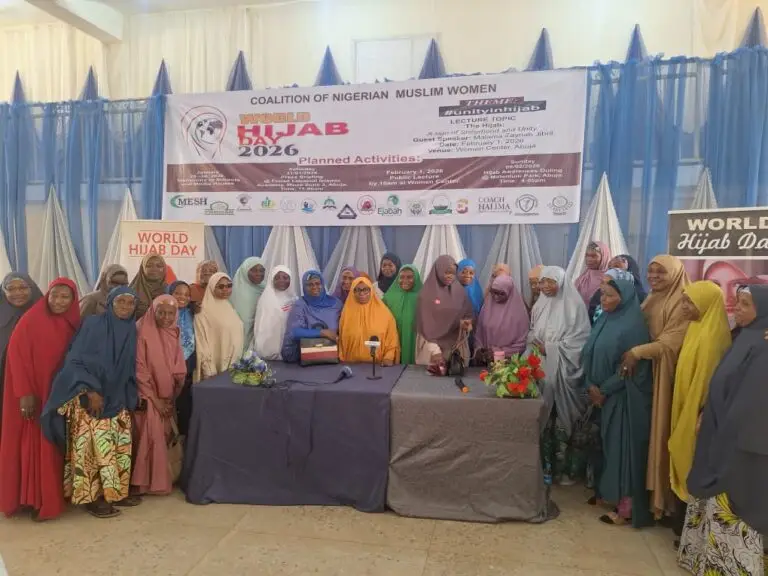
A Coalition of Nigerian Muslim women has called on the Federal Government to review the uniforms of the National Youth Service Corps (NYSC) to ensure adequate inclusion of Muslim female corps members
Ms Firdausi Amasa, a member of the coalition, made the call at a news briefing to mark the 2026 World Hijab Day, held in Abuja, on Saturday.
The News Agency of Nigeria (NAN) reports that the day, marked annually on February 1, every year, is a powerful global platform that highlights the beauty and significance of the Muslim woman’s dress.
The initiative was founded by Nazma Khan in 2013, inspired by her personal journey of resilience after experiencing verbal and physical challenges for choosing to wear the hijab.
Amasa said, “Since its inception, World Hijab Day has grown remarkably, touching lives in over 190 countries, including Nigeria, and fostering understanding and unity across diverse communities.”
NAN reports that the theme for 2026 World Hijab Day is “#Unityinhijab.”
Amasa said that that the current uniform of the NYSC was highly inadequate for Muslim female corps members, adding that there was the need for an overhaul of the NYSC dress code to properly include Muslim female corps members and others.
She added, “We propose that Muslim students be allowed to wear a knee length hijab. Also, they should be exempted from the compulsory requirement to wear shorts for parade and wear long, free, white trousers instead.”
She emphasised the need for the National Assembly to prioritise the swift passage of outstanding bills to safeguard against discrimination based on appearance or faith.
Amasa said, “These legislations will demonstrate Nigeria’s commitment to justice and equity. The society must actively support reverts who choose to wear the hijab, recognising the challenges they often face from loved ones and communities.
“Acceptance, encouragement, and a prejudice-free environment are essential for their journey. Special attention should be given to those facing unique challenges by offering counseling and inclusive support to build their confidence.”
Amasa, who is a legal practitioner, advocated community-driven programme that empower hijab-wearing women through mentorship, skill development, and leadership training.
“These initiatives should connect accomplished professionals with younger women for guidance, equip them with tools to excel in STEM fields, entrepreneurship, and governance, and prepare them for advocacy roles.
“The hijab should be viewed as a symbol of empowerment rather than restriction. We urge individuals, institutions, and leaders to acknowledge the hijab as a reflection of identity, values, and inclusivity.
“It connects women across diverse backgrounds while fostering understanding and unity. Let us embrace the hijab not as a barrier but as a powerful tool for promoting opportunity, respect, and diversity,” she said.
Amasa called on government agencies, schools and private establishments to implement services that are inclusive of individuals whose appearance reflects their religious beliefs.
According to her, institutions must accommodate hijab-wearing women and recognise the critical role of women in national development.
“Additionally, strict accountability measures should be enforced to address alleged harassment or discrimination against hijab-wearing individuals by public and private institutions.
“We call on schools to respect the Constitution of the land and the Pronouncements of the Apex Court on the inalienable right of Female Muslims to adorn hijab.
“This is imperative so we don’t have to go through additional litigation to enforce the already established right,” she said.
Amasa also emphasised the need for the media to challenge stereotypes by promoting positive representations of hijab-wearing women.
She added, “Stories should highlight their achievements as leaders, professionals, and role models while breaking down misconceptions about the hijab.
“Collaborations with organisations such as this Coalition can amplify these narratives on mainstream platforms, emphasizing that the hijab enhances rather than limits potential.
“This approach will foster inclusivity, break barriers, and promote diversity in public discourse.
“By addressing these key areas with clarity and focus, we can collectively advance the rights of hijab-wearing women while fostering an inclusive society that respects diversity and empowers all individuals.”
On her part, Ms Zainab Umar, commended the Federal Ministry of Education, NYSC, Council of Legal Education, Supreme Court of Nigeria, the Nigerian Armed Forces, the Nigeria Police, and other institutions for their support to Muslim women.
“These efforts have been instrumental in advancing the rights and dignity of hijab-wearing women, ensuring their inclusion and respect in all spheres of life.
“This strengthens our bond and encourages further collaborations,” she said.
