

Gaza farmers brave Israeli fire to revive devastated farmlands

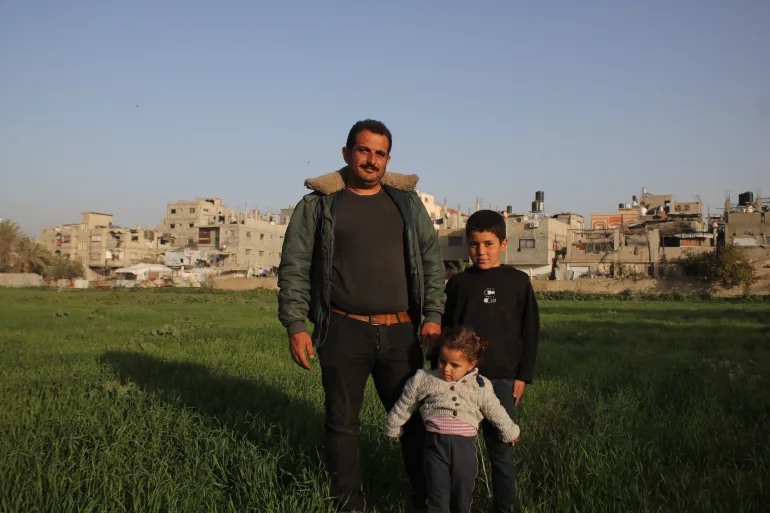
In the battered fields of the Gaza Strip, Palestinian farmers are risking their lives to restore agriculture amid expanding Israeli military buffer zones and continuing security threats.
When a fragile ceasefire began in October, Mohammed al-Slakhy and his family returned to their farmland in the Zeitoun area of Gaza City, determined to rebuild what years of war had destroyed. Their greenhouses lay in ruins, irrigation systems were flattened, and wells, solar units and desalination plants had been wiped out. Still, with scarce resources, they cleared rubble, prepared the soil and planted their first courgette crop in hopes of harvesting in early spring.
But farming has become a life-threatening task. Israeli tanks sit only a few hundred metres away, and gunfire is a constant presence. “Every time I go to the field, I’m risking my life,” Mohammed said, describing repeated incidents of tanks advancing close to his land and opening fire.
Before the war, Mohammed’s family farm supplied large volumes of vegetables for local markets and for export to the occupied West Bank and abroad. Today, more than three hectares of his farmland have been levelled, reflecting a wider collapse of Gaza’s agricultural sector.
A July 2025 report by the Food and Agriculture Organization found that over 80 percent of Gaza’s cropland had been damaged, with less than five percent still available for cultivation. Since then, conditions have worsened as Israel expands so-called buffer zones across the east, north and south of Gaza, areas that were once largely productive farmland.
Many Palestinians fear the buffer zones may become permanent. Maps linked to US President Donald Trump’s proposed Board of Peace plan reportedly show vast agricultural areas erased, deepening concerns over land loss.
Mohammed can now access only one hectare of the more than 22 hectares his family once farmed. The rest lies inside Israeli-controlled zones. His remaining plot sits just 200 metres from the demarcation line, where tanks frequently move and fire.
On February 12, Israeli tanks advanced into Salah al-Din Street and opened fire, killing two Palestinians and wounding several others. Mohammed was working nearby. “A tank approached and opened fire towards us. I hid behind a destroyed building for over an hour before I could escape,” he recalled.
Similar fears haunt farmers in central Gaza. In Deir el-Balah, 75-year-old Eid al-Taaban says his land lies only 300 metres from Israeli-controlled areas. “We planted eggplants after the ceasefire, but now we can’t reach them. The sound of heavy machine guns is constant,” he said. In February, his neighbour Khaled Baraka was reportedly killed while working on his land, deepening local fears.
Beyond military threats, the Israeli blockade has crippled farming efforts. Since October 2023, the entry of seeds, fertilisers, pesticides, irrigation equipment and machinery has been severely restricted. Shortages, expired supplies and soaring prices have made cultivation increasingly difficult, while many crops fail due to poor-quality or ineffective inputs.
Even when farmers manage to harvest, the market offers little relief. Israeli produce often floods Gaza at lower prices, undercutting local farmers who struggle to compete. With Gaza’s economy shattered, many residents cannot afford higher-priced local produce, forcing farmers to sell at a loss or watch crops rot.
“I had to sell below production cost or lose everything,” Mohammed said. “We’ve received no compensation or support.”
Yet despite the danger, scarcity and losses, Gaza’s farmers remain determined. For them, agriculture is more than survival—it is identity, heritage and resistance.
“Agriculture is our life,” Mohammed said. “It is part of who we are. Despite the destruction and danger, we will replant every piece of land we can reach.”
For Eid, farming is a legacy passed down generations, tracing back to his family’s roots in Beersheba before the 1948 Nakba. “My grandfather taught my father, my father taught me, and now I teach my grandchildren,” he said. “The love of the land cannot be taken from us.”
