

Sasakawa Africa Association showcases achievements in Jigawa, expands solar irrigation, agro-processing, agribusiness support

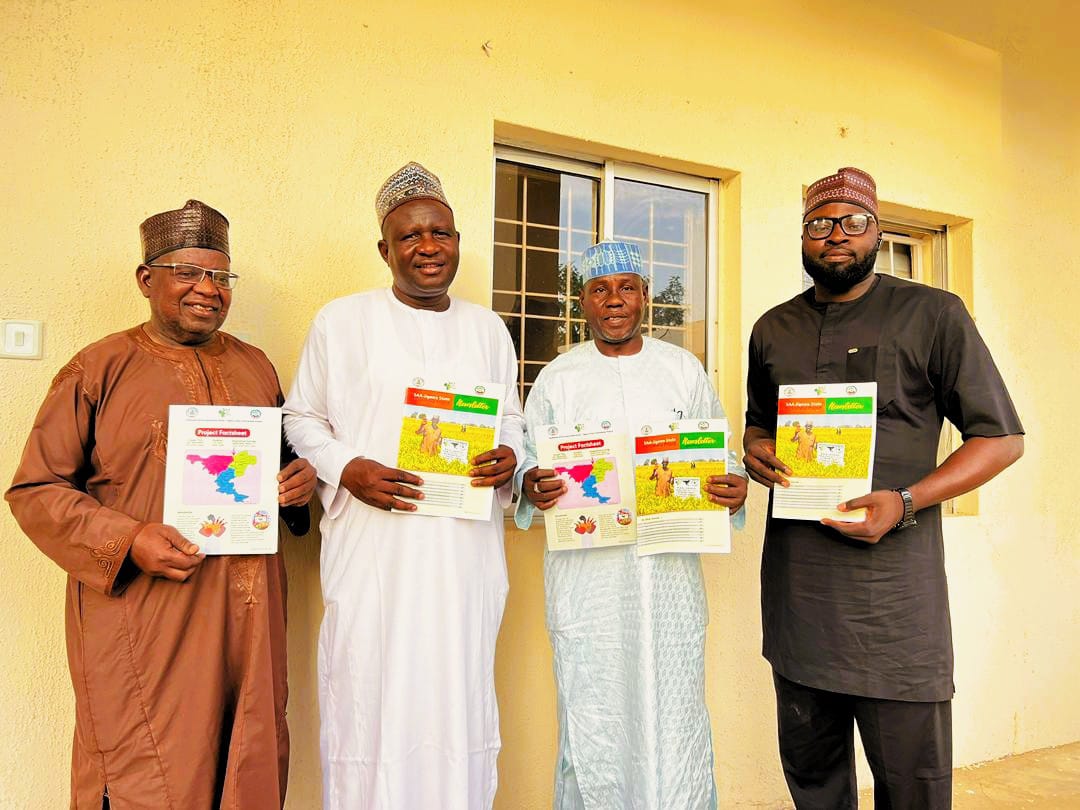
Jigawa State Government has reaffirmed its commitment to agricultural transformation through sustained collaborations and partnerships. The development followed a high-level progress review meeting and presentation of project achievements by the Sasakawa Africa Association (SAA), showcasing tangible gains recorded across farming communities under the SAA–Jigawa State Partnership Project.
The meeting which held early February at the Jigawa State Ministry of Agriculture, reviewed implementation progress for 2025 and agreed on priorities for the 2026 agricultural seasons. The state government was represented by the Managing Director of the Jigawa State Agricultural Development Authority (JARDA), Alhaji. Imam Mohammed, alongside the Secretary of the State Technical Committee on Agriculture, Alhaji. Abubakar Garba, and other senior officials. The SAA delegation was led by Mr. Albert Taru, Project Lead, supported by Mr. Idris Garko and the Communication Officer, Mr. Moses Nongoatse.
During the meeting, the SAA team presented results from the ongoing 2025 implementation period, covering measurable progress in farmer outreach, productivity enhancement, and strengthening extension delivery system. Between June and December 2025 alone, the project successfully engaged over 500 community stakeholders across 14 communities, trained 100 extension agents and lead farmers to enhance technical backstopping, and reached 919 direct beneficiary farmers through step-down delivery of Good Agronomic Practice (GAP) trainings across target LGAs. These outcomes reflect the project’s growing impact and effectiveness of its cascade training model.
Speaking on the outcome of the engagement, the Alhaji Imam Mohammed, described the partnership as a results-oriented intervention aligned with the state’s food security and rural development priorities.
“What is important to us is evidence of impact. The progress recorded under this partnership from farmer training to improved yields confirms that targeted extension and farmer-centered support can deliver real results. The Jigawa State Government remains committed to sustaining this collaboration so that more farmers benefit,” Mohammed stated.
Project data presented during the meeting showed that with funding from Jigawa State government SAA supported the establishment of 36 wet-season community demonstration and seed multiplication plots for rice, sorghum, and cassava, as well as 28 dry-season wheat plots across selected LGAs. These platforms served as hands-on learning sites for farmers and extension agents the results recorded were highly encouraging participating farmers achieved. Rice yields increased ranging from 43–48 percent, while sorghum yields rose by over 60 percent compared to baseline levels, in addition, two Mega Field Days organized in Kaugama and Taura LGAs attracted 428 participants, creating robust platforms for knowledge exchange, peer learning and live technology demonstrations.
The event clearly showed the effectiveness of improved seed varieties and climate-smart agronomic practices. Further reinforcing their effectiveness and scalability across the state.
In addition to crop production, the SAA placed strong emphasis on farmer organization and value addition. A needs assessment of 28 farmer groups was completed to prepare them for tailored empowerment support in 2026, including processing equipment, solar irrigation technologies, and agribusiness development.
According to Mr Albert Taru, Project Lead at SAA, the progress achieved reflects the SAA’s long-standing commitment to impactful value chain extension delivery.
“These results show that when extension systems are strengthened and farmers are properly supported, productivity improves. SAA, through the Jigawa State Government will continue to deliver lasting benefits through this project,” he said.
Beyond field activities, the partnership also strengthened visibility and public accountability. Seven radio programs episodes were aired during the reporting period, while Information, Education and Communication (IEC) materials were produced and disseminated to ensure wider awareness of government-supported agricultural interventions.
In his remarks, Mr. Idris Garko commended the Jigawa State Government for its leadership and consistency, noting that even ahead of full counterpart funding, SAA supported by the Nippon Foundation continued to deploy technical expertise to sustain farmer-level impact.
The February 2026 review builds on the renewed five-year partnership formalized in October 2025 through an Addendum to the 2011 Memorandum of Understanding between SAA and the Jigawa State Government. Plans for 2026 include the distribution of empowerment packages to 19 farmer groups, expanded compost and biochar training for 250 farmers and extension agents, and additional radio programming to deepen outreach.
