


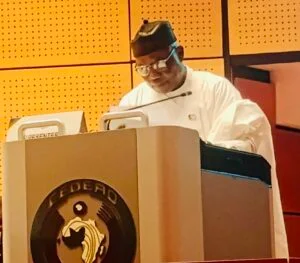
The Economic Community of West African States (ECOWAS) has introduced a new six-pillar strategic framework tagged the “Compact of the Future of Regional Integration,” designed to redefine the bloc’s political and economic direction amid growing regional challenges.
ECOWAS Commissioner for Political Affairs, Peace and Security, Amb. Abdel-Fatau Musah, presented the initiative during the ongoing First Ordinary Session of the ECOWAS Parliament in Abuja.
Musah described the proposal, which comes ahead of a planned special summit of regional leaders, as a survival strategy intended to strengthen regional integration and reposition ECOWAS in response to rising political, economic and security pressures across West Africa.
He said the ultimate objective is to transform ECOWAS from an institution largely associated with issuing declarations into one that delivers tangible public goods, including security, economic mobility and digital connectivity, to citizens.
“The Compact is designed to operationalise the ECOWAS Vision 2050, and represents a fundamental reset of the regional integration agenda, shifting the bloc from an elite-driven ECOWAS of States to ECOWAS of the Peoples.
“This initiative acknowledges that the regional body is at its most fragile point since its establishment in 1975, due largely to governance failures, democratic setbacks and the emergence of alternative alliances such as the Alliance of Sahel States (AES), comprising Burkina Faso, Mali and Niger,” he said.
Musah noted that the strategy was adopted by the ECOWAS Authority of Heads of State and Government at a summit in Abuja, where leaders also called for a special summit on the future of regional integration.
He added that the draft framework was developed after extensive consultations involving citizens across West Africa, civil society organisations, the African diaspora, ECOWAS institutions and regional leaders.
“The Compact for the Future of Regional Integration seeks to rebuild trust between states and their peoples, ensuring that regional integration remains relevant, citizen-centred and capable of responding to 21st-century challenges.”
“This is due largely to governance failures, democratic setbacks and the emergence of alternative alliances such as the Alliance of Sahel States (AES), comprising Burkina Faso, Mali and Niger,” he said.
According to him, the initiative is structured around six key pillars: sustainable economic transformation, peace and democratic governance, science and technology, social inclusion, institutional reform and ECOWAS geopolitical positioning.
“Under the economic transformation pillar, ECOWAS aims to double intra-regional trade to 30 per cent by 2035, promote industrialisation and food sovereignty, and implement the ECO single currency by 2040.
“On governance and security, the document reaffirms zero tolerance for military coups and unconstitutional manipulation of civilian constitutions, while proposing a stronger ECOWAS Standby Force to address emerging threats.
“The science and technology pillar envisions the establishment of a Digital Single Market by 2030, while the social inclusion component seeks to raise women’s representation in leadership to 40 per cent and institutionalise youth participation in governance,” he said.
Musah further explained that the Compact also proposes institutional reforms aimed at making ECOWAS bodies more merit-based, accountable and fully self-financed through the Community Levy by 2030.
He added that a major feature of the framework is its emphasis on “strategic autonomy,” positioning ECOWAS as a unified geopolitical actor capable of defending West Africa’s interests in an increasingly multipolar global order.
According to him, the document also provides for structured dialogue and confidence-building measures with the Sahel states of Mali, Burkina Faso and Niger, in a bid to prevent their permanent exit from the regional bloc.
“To address ECOWAS’ longstanding implementation deficit, the Compact introduces a robust monitoring and evaluation system, including compliance scorecards for member states and an evidence-based approach to policy implementation,” Musah added.
The News Agency of Nigeria (NAN) reports that lawmakers at the ECOWAS Parliament engaged extensively with the proposal, deliberating on its wide-ranging implications for the region’s future integration agenda.
