


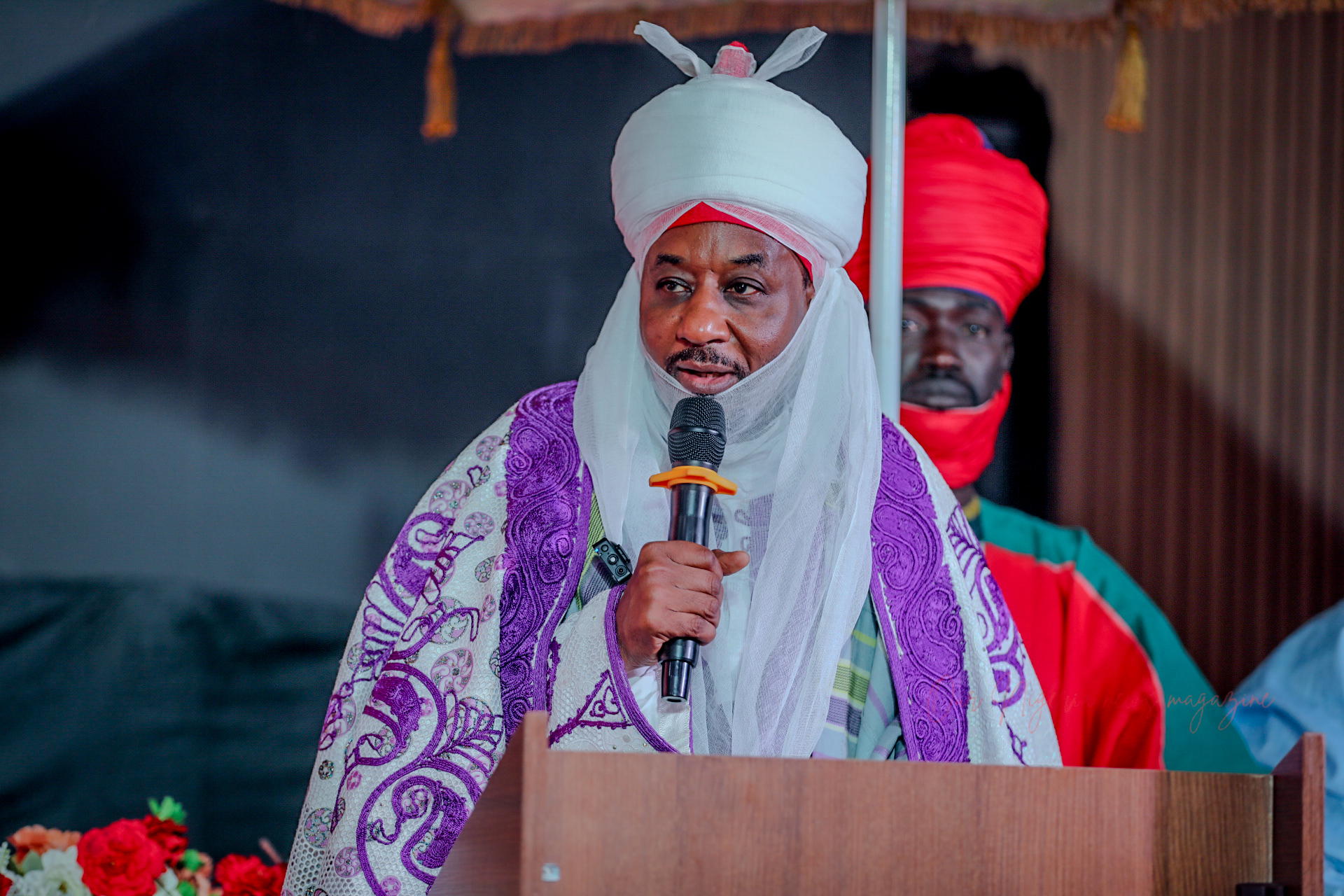
The Emir of Kano, Muhammadu Sanusi II; Minister of Defence, Gen. Christopher Musa (rtd); and Senator representing Borno South, Mohammed Ali Ndume, have called for stronger institutions, national unity and holistic approaches to insecurity as they paid tribute to the leadership legacy of former Chief of Army Staff, Lt. Gen. Tukur Buratai (rtd.).
The trio spoke at the public presentation of “Military Transformational Leadership in Action: The Buratai Era,” a book authored by Dr. M.S. Abubakar, which examines Buratai’s leadership and reforms as Chief of Army Staff.
Sanusi, in his remarks, said Nigeria’s security crisis could not be understood solely from the perspective of terrorism and banditry, arguing that the problem had deeper social and political roots.
He said the crisis was preceded by what he described as the “violence in words” manifested in political and public discourse, where Nigerians increasingly categorised themselves along ethnic and religious lines.
According to him, the politicisation of ethnicity and religion created an environment conducive to the emergence and growth of violent movements.
Sanusi urged Nigerians to reverse the trend and rebuild a sense of national identity, saying the country must return to seeing itself primarily as a nation of Nigerians and focus on the development of its people.
He said politicians should concentrate on providing education, healthcare and economic opportunities, while religious affairs should largely remain within the domain of religious leaders.
“It is also not the duty of religious leaders to get into politics,” he said, warning against the blurring of the roles of religious and political leaders.
The Emir also used the occasion to weigh in on the debate over whether Nigeria needed stronger leaders or stronger institutions, saying the country required both.
According to him, strong leadership cannot deliver sustainable results where institutions are weak, while strong institutions can also be undermined by poor leadership.
He said institutional strength should be measured by adherence to legal and institutional frameworks rather than the ability to exercise power.
Sanusi called for an end to the politicisation of institutions such as the military, police, judiciary, central bank and the media, stressing that such institutions must retain sufficient independence to check political authority.
He noted that political office holders generally operate within electoral cycles, while national institutions must think in terms of decades.
He added that transformational leadership should be measured by whether reforms and institutions continued to function effectively after the departure of the individual who initiated them.
“Leadership is only transformative if it outlives you,” Sanusi said.
The Emir also drew attention to the relationship between economic conditions and insecurity, warning that poverty, unemployment, lack of education and absence of economic opportunities could make citizens vulnerable to manipulation and recruitment by violent groups.
He called for greater investment in areas capable of creating jobs and reducing future poverty, particularly for young Nigerians.
“We need to build an economy,” he said, stressing that economic development should complement military efforts to address insecurity.
Sanusi commended members of the armed forces who had sacrificed their lives in the defence of the country and expressed hope that Nigeria would return to an era of peace and security.
Senator Ndume, who said he was part of the security efforts during the Buratai era, described security as a collective responsibility involving traditional rulers, religious leaders, community leaders, the military, police, judiciary and political leaders.
He similarly rejected attempts to portray insecurity as a problem peculiar to a particular region or religious group.
“It’s not a Northern problem. It’s not a Muslim problem. It’s not a Christian problem. It is a Nigerian problem,” Ndume said.
The senator said Nigerians had lost part of their sense of national identity and needed to rebuild the idea of one Nigeria.
Ndume recalled the security situation before Buratai assumed office as Chief of Army Staff, saying the country had reached a point where movement and social activities in some areas were severely restricted by insecurity.
He credited Buratai with providing leadership to the Nigerian Army during a difficult period and commended officers who worked under challenging circumstances to improve the security situation.
The senator also acknowledged the role of the present administration in improving military welfare and funding, citing increases in soldiers’ salaries and defence allocations.
Ndume, however, used the occasion to challenge Nigerians to take responsibility for the quality of political leadership in the country.
He argued that politicians are products of the society and that citizens have a role in determining who occupies political offices.
“Politics is people,” he said, urging Nigerians to participate more actively in democratic processes rather than placing all responsibility for national challenges on politicians.
Ndume also stressed his belief in Nigeria, saying the country had the capacity to overcome its challenges if citizens remained committed to its development.
The Minister of Defence, Gen. Christopher Musa (rtd), described himself as a direct beneficiary of Buratai’s legacy in the Nigerian Armed Forces, particularly the Nigerian Army.
Musa said Buratai acted quickly to address challenges confronting the Army when he assumed office and demonstrated what he described as commitment to institutional reform.
One of the qualities he highlighted was Buratai’s ability to identify and develop future military leaders.
According to Musa, several officers given opportunities to serve under Buratai subsequently rose through the ranks to become senior military commanders.
He said this demonstrated the former Army chief’s understanding that leadership succession and institutional continuity were important components of transformation.
Musa also recalled Buratai’s demanding work schedule and accessibility, describing his responsiveness to officers and colleagues as an indication of his commitment to duty.
He urged military personnel, students, policymakers and others interested in leadership to read the book, saying it contained lessons on sacrifice, commitment and institutional transformation.
He challenged public officials and professionals to regularly ask themselves what positive contribution they were making to the country.
Speaking as a panelist, an expert in public administration and good security-sector governance, Prof. Philip Dahida, said the Buratai era provided several examples of institutional and practical responses to Nigeria’s security challenges.
Dahida said Buratai established military formations and institutional frameworks intended to strengthen operations against insecurity, particularly the Boko Haram insurgency.
He also highlighted the emphasis placed on civil-military relations, saying communities, traditional rulers, religious leaders and opinion leaders were brought into the security process.
According to him, engagement with communities also created opportunities to address radicalisation and involve young people in efforts against violent extremism.
Dahida said the experience demonstrated that Nigeria’s security challenge could not be solved by the military alone.
He called for cooperation among political leaders, traditional institutions, religious leaders, communities and other stakeholders, warning that factors such as hate speech, political tensions and local support networks could contribute to insecurity.
He advocated greater unity, inclusion and pragmatic leadership, with particular emphasis on creating opportunities for young people to participate in national development.
He also called for the empowerment and inclusion of women, students, market women and other community groups in national security and development discussions.
The presentations collectively framed the Buratai era as a case study in military leadership, institutional reform, civil-military relations and the development of future commanders.
The book, “Military Transformational Leadership in Action: The Buratai Era,” seeks to document and examine the leadership experience of the former Army chief while drawing broader lessons for military professionals, policymakers, students and the Nigerian public.
The speakers also stressed that the country’s security challenges require more than military action, pointing to the importance of political responsibility, economic opportunity, institutional independence, community participation and national cohesion.
The event therefore became not only a celebration of Buratai’s military career but also a broader discussion on how leadership, institutions and society can combine to address Nigeria’s security and development challenges.
