

Artemis II Astronauts Return to Earth After Historic Lunar Flyby Mission

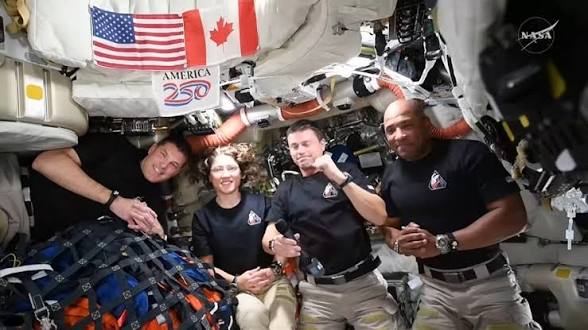
The crew of Artemis II has safely returned to Earth, splashing down in the Pacific Ocean off the coast of California and marking the first human journey to the Moon in more than 50 years.
The four astronauts Reid Wiseman, Victor Glover, Christina Koch and Jeremy Hansen emerged from their Orion spacecraft after a high-speed reentry, concluding a mission that sets the stage for a crewed lunar landing within the next two years.
Their capsule endured extreme temperatures as it reentered Earth’s atmosphere at speeds exceeding Mach 30, briefly losing communication during a planned blackout before successfully deploying parachutes and landing safely at sea. Recovery teams transported the astronauts to a nearby U.S. Navy ship shortly after splashdown.
The mission represents a major milestone for NASA’s long-term lunar ambitions. Officials say Artemis II paves the way for future missions aimed at establishing a sustained human presence on the Moon later this decade.
“This crew represented humanity at its best,” said NASA Administrator Jared Isaacman, praising the astronauts’ performance and the mission’s success.
Launched on April 1, Artemis II carried humans farther from Earth than ever before, surpassing the distance record set during Apollo 13. The crew reached more than 406,000 kilometres from Earth during their lunar flyby.
Although the spacecraft did not land on the Moon, astronauts captured unprecedented views of the lunar far side, witnessed a total solar eclipse, and photographed Earth rising beyond the Moon’s horizon echoing the iconic imagery from Apollo 8.
The mission also marked a milestone in representation: Koch became the first woman to travel to the Moon, Glover the first Black astronaut to do so, and Hansen the first non-American astronaut on a lunar mission.
With Artemis II complete, NASA is now preparing for its next phase returning humans to the lunar surface and laying the groundwork for a permanent Moon base.
