


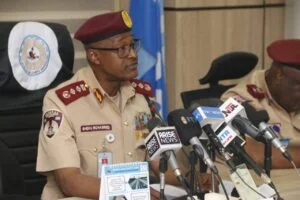
The Federal Road Safety Corps (FRSC) says its 38 years of existence have significantly transformed Nigeria’s road safety management system from an era of fragmented enforcement into a coordinated, data-driven institutional framework aligned with global best practices.
The Corps Public Education Officer (CPEO), Olusegun Ogungbemide said this in an interview with the News Agency of Nigeria (NAN) to commemorate the Corps’ 38th anniversary on Wednesday in Abuja.
Ogungbemide recalled that Nigeria recorded 40,881 Road Traffic Crashes (RTCs) in 1976, a development that exposed the absence of a coordinated national response to road safety challenges.
This, he said, triggered widespread concern both locally and internationally.
According to him, sustained advocacy by prominent Nigerians, including Nobel Laureate Wole Soyinka, helped galvanise national consciousness.
“This also helped towards establishing a structured intervention to reduce avoidable deaths on Nigerian roads.”
The FRSC spokesman explained that the advocacy culminated in 1988 when former Military President Ibrahim Babangida established the FRSC through Decree No. 45 of 1988, now the FRSC (Establishment) Act, 2007.
“The Corps was conceived in line with the United Nations’ lead agency model, which assigns a single institution responsibility for coordinating road safety strategy, policy, enforcement and data management,” he said.
Ogungbemide noted that at inception, the Corps faced widespread challenges including weak compliance with traffic regulations, fragmented enforcement mechanisms and poor crash rescue systems.
He said sustained public enlightenment campaigns, strengthened patrol operations and improved stakeholder engagement.
He added that enhanced emergency rescue services had gradually shifted the narrative toward institutional coordination and prevention-driven safety management.
He highlighted landmark reforms introduced by the Corps, including the National Driver’s Licence Scheme and harmonised vehicle number plate administration.
This, he said included the “One Driver, One Record” database architecture aimed at improving accountability within Nigeria’s road transport system.
He added that the introduction of the toll-free 122 emergency number and a 24-hour call centre had significantly improved response time to crash scenes and strengthened post-crash care in line with global safety standards.
According to him, more than 95 per cent of FRSC administrative and operational processes are now digitalised, positioning the Corps among Nigeria’s most technologically advanced law enforcement institutions.
Ogungbemide also said the Corps remained the only paramilitary organisation in the country to attain ISO certification consecutively four times.
He stated that the current leadership of the Corps Marshal Shehu Mohammed, had focused on consolidating institutional gains through professionalism, discipline and intelligence-led operations.
“Enforcement strategies are increasingly predictive rather than reactive, leveraging crash data analytics to identify high-risk corridors and behavioural trends.
“Strengthened inter-agency collaboration, enhanced operational visibility and continuous personnel capacity building had further improved service delivery nationwide,” he said.
The FRSC spokesman said stakeholder partnerships involving transport unions, fleet operators, state traffic agencies and community organisations had also been reinforced to promote shared responsibility in road safety management.
Ogungbemide described the Corps’ nationwide structure, comprising zonal, sector and unit commands, roadside clinics, emergency ambulance points, licence centres, production facilities and specialised training institutions as evidence of institutional maturity and resilience.
He noted that the integration of Regular Marshals and Special Marshals had strengthened grassroots advocacy and compliance monitoring across communities.
Ogungbemide further listed regulatory initiatives such as the Driving School Standardisation Programme (DSSP), Road Transport Safety Standardisation Scheme (RTSSS), speed management enforcement and the Safe-to-Load process as measures designed to entrench safety culture within Nigeria’s mobility system.
On the international stage, he said FRSC had continued to serve as a reference institution in road safety governance through technical collaborations, knowledge exchange and alignment with the five pillars of global road safety.
He observed that road transport accounts for more than 90 per cent of passenger and freight movement in Nigeria.
He however, stressed that rising vehicle ownership and expanding economic corridors would require sustained political support, infrastructure investment and technological innovation.
“Thirty-eight years after its establishment, the FRSC has evolved from a visionary intervention into Africa’s model lead agency in traffic and safety administration.
“The Corps’ achievements reflected the impact of consistent leadership, institutional vision and collective national commitment to safeguarding lives on Nigerian roads,” he said.
Ogungbemide congratulated the Corps Marshal, past chairmen of the FRSC Commission, former Corps Marshals, officers and personnel of the Corps on the anniversary, expressing optimism for more service-oriented years ahead.
He reaffirmed the Corps commitment to its mandate of creating a safer motoring environment for all road users in Nigeria.
