

US Steps Up Military Support, Intelligence Sharing With Nigeria to Counter IS-Linked Militants

By Halima Abdulkadiri
The United States is ramping up military support and intelligence sharing with Nigeria as part of a broader effort to combat Islamic State-linked militants across Africa, the deputy commander of US Africa Command (Africom) has said.
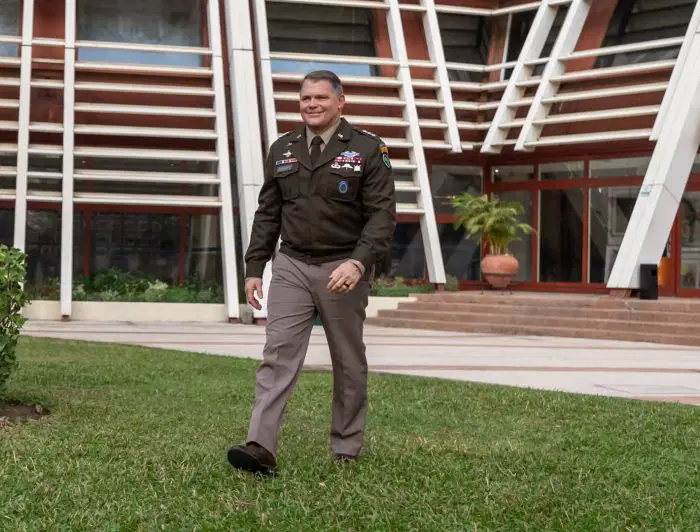
Lieutenant General John Brennan told AFP that the US military is increasing materiel deliveries and intelligence cooperation with Nigeria, while also maintaining communication with armed forces in junta-led Sahel countries including Burkina Faso, Niger and Mali.
According to Brennan, the expanded cooperation with Abuja follows sustained diplomatic pressure from Washington over jihadist violence in Nigeria, alongside a more aggressive US military posture against Islamic State (IS)-affiliated groups on the continent.
“Under the Trump administration, we’ve gotten a lot more aggressive and are working with partners to target, kinetically, the threats, mainly ISIS,” Brennan said during an interview on the sidelines of a US-Nigeria security meeting held in Abuja last week.
“From Somalia to Nigeria, the problem set is connected. So we’re trying to dismantle it and provide partners with the information they need,” he added.
Brennan said US support is increasingly focused on enabling African partners by easing restrictions on equipment and capabilities to help them operate more effectively.
The comments came after the inaugural meeting of the US-Nigeria Joint Working Group, held about a month after Washington announced surprise Christmas Day airstrikes on IS-linked targets in northwest Nigeria.
Despite growing military cooperation, diplomatic tensions remain over US claims of widespread killings of Christians in Nigeria. Abuja and several independent analysts have rejected this framing, arguing that Nigeria’s security challenges are complex and cut across religious and ethnic lines.
The issue surfaced at the Abuja meeting, where senior US State Department official Allison Hooker urged Nigeria to “protect Christians” in a speech that did not reference Muslim victims of armed violence.
Brennan, however, stressed that US intelligence support would not be limited to protecting Christians alone. He said future American assistance would focus on intelligence sharing to support Nigerian air operations in Sokoto State and the northeast, where Boko Haram and its Islamic State-aligned splinter group, the Islamic State West Africa Province (ISWAP), have waged an insurgency since 2009.
“ISWAP is our most concerning group,” Brennan said.
Analysts have recently tracked increased US intelligence flights over Nigeria, though some experts question whether air power alone can defeat armed groups operating in areas plagued by poverty and weak state presence.
Brennan also said US-Nigeria cooperation would cover a wide range of areas, including intelligence sharing, operational tactics and assistance in acquiring military equipment.
The Christmas Day strikes, he noted, targeted militants linked to the Islamic State Sahel Province, a group typically active in neighbouring Niger, amid concerns about its expansion toward coastal West African countries such as Nigeria.
However, the impact of the strikes remains unclear, with journalists unable to independently verify militant casualties. Nigeria’s Information Minister, Mohammed Idris, described the operation last week as “still a work in progress.”
Beyond Nigeria, Brennan said the US continues to collaborate informally with the militaries of Burkina Faso, Mali and Niger, despite reduced official cooperation following a series of coups between 2020 and 2023.
“We have actually shared information with some of them to attack key terrorist targets,” he said, adding that communication with Sahelian military partners remains ongoing, though unofficial.
He also clarified that the US is not seeking to establish new military bases in the region following its withdrawal from Niger.
“We’re not in the market to create a drone base anywhere,” Brennan said, referring to the closed US drone facility in Agadez. “Our focus is on delivering capability where it’s needed and then leaving. We don’t seek long-term basing in West Africa.”
