

Yunus Says Bangladesh Has Shed ‘Submissive’ Foreign Policy, Cites India’s ‘Seven Sisters’ in Farewell Speech

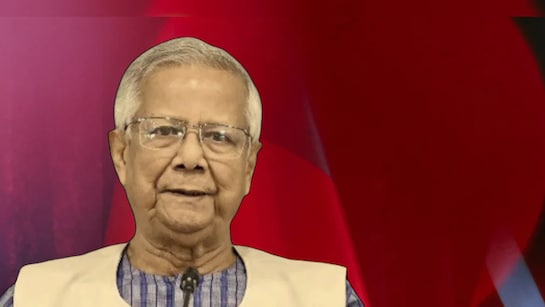
In a farewell address on Monday, Bangladesh’s interim government chief, Muhammad Yunus, declared that the country had reclaimed its sovereignty, dignity, and national interests, insisting that Bangladesh was no longer a nation guided by a “submissive foreign policy.”
Speaking after 18 months in office, Yunus said Bangladesh no longer relied on the “instructions and advice of other countries,” a remark widely seen as a veiled criticism of India, amid recent diplomatic tensions between the two neighbours.
Yunus assumed leadership following the student-led uprising that led to the ousting of former prime minister Sheikh Hasina in 2024. His address came ahead of the swearing-in of Tarique Rahman, leader of the Bangladesh Nationalist Party, who won the general elections nearly two years after the political upheaval.
In his speech, Yunus described Bangladesh’s access to the sea as a major “strategic asset” capable of transforming the nation’s economic future. He stressed the potential for regional economic cooperation with neighbouring countries, including Nepal, Bhutan, and India’s northeastern states, collectively known as the Seven Sisters.
“Our open seas are not just borders — they are gateways to the global economy,” Yunus said. “With Nepal, Bhutan, and the Seven Sisters, this region offers immense economic potential. Through economic zones, trade agreements, and duty-free market access, we can establish Bangladesh as a global manufacturing hub.”
His reference to the “Seven Sisters” without directly naming India drew attention, with analysts interpreting it as a deliberate emphasis on the region’s economic identity rather than its political alignment.
Yunus had made a similar statement last year during a visit to China, where he said the seven northeastern Indian states were effectively landlocked by Bangladesh. “The seven states in eastern India, known as the ‘Seven Sisters,’ are entirely landlocked and have no direct access to the ocean. We are the only guardians of the sea for this entire region,” he said at the time.
The remarks underline Yunus’s vision of positioning Bangladesh as a central economic and maritime gateway for South Asia, as the country prepares for a new political era following the transition of power.
