

World’s Oldest Cave Paintings Discovered on Indonesia’s Muna Island

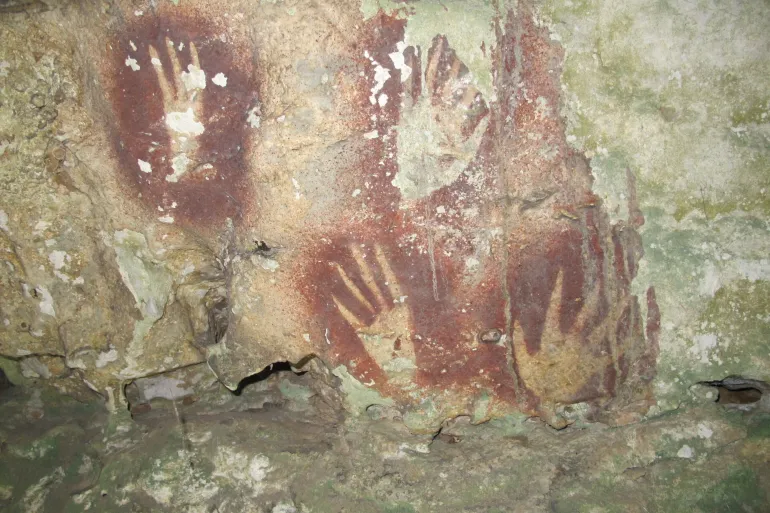
Archaeologists have identified hand stencils on limestone caves on Indonesia’s Muna Island as the world’s oldest known cave paintings, with some estimated to be up to 67,800 years old.
The discovery, announced on Wednesday, follows analysis by Indonesian and Australian researchers who found that the tan-coloured handprints were created by blowing pigment over hands pressed against cave walls, leaving distinctive outlines.
According to researchers, the hand stencils were uncovered beneath younger cave paintings depicting a human riding a horse alongside a chicken. Archaeologist Adhi Agus Oktaviana of Indonesia’s National Research and Innovation Agency (BRIN) said he had been searching for such hand stencils in the Muna Island area, part of Sulawesi province, since 2015.
Initially, Oktaviana said it was difficult to convince colleagues that the markings were human hands, but further examination revealed finger-like shapes, some of which appeared deliberately sharpened to look pointed.
Maxime Aubert, an archaeological science specialist at Australia’s Griffith University and a lead author of the study published in the journal Nature, said the stencils belong to a unique artistic style found only in Sulawesi.
“The tips of the fingers were carefully reshaped to make them appear pointed,” Aubert said, noting that the design suggests symbolic intent.
His co-author, Adam Brumm, also of Griffith University, said the artists may have been attempting to transform the image of a human hand into something else, possibly an animal claw.
“Clearly, these images held deeper cultural meaning, though we don’t yet know what that meaning was,” Brumm said, adding that the art may reflect a complex symbolic relationship between early humans and animals.
The researchers dated the paintings by analysing uranium traces in mineral layers that formed over the pigment. Using laser technology to measure the decay of uranium into thorium, scientists were able to establish a minimum age for the artwork with high precision.
The study also found that the caves were used repeatedly for rock art over tens of thousands of years, with some images painted over as much as 35,000 years later. The newly dated stencils are more than 15,000 years older than previous cave art discoveries in Sulawesi made by the same team in 2024.
Indonesia and its surrounding region, including East Timor and Australia, are known for some of the world’s oldest archaeological evidence of human culture. Oktaviana said the cave art strengthens the theory of early human migration through Sulawesi.
“It shows that our ancestors were not only skilled seafarers, but also artists,” he said.
Archaeological evidence suggests Aboriginal Australians possess one of the world’s oldest continuous living cultures, dating back at least 60,000 years. In northwestern Australia, the Murujuga rock art site—home to an estimated one million ancient petroglyphs, some possibly 50,000 years old—was recently added to UNESCO’s World Heritage list.
