


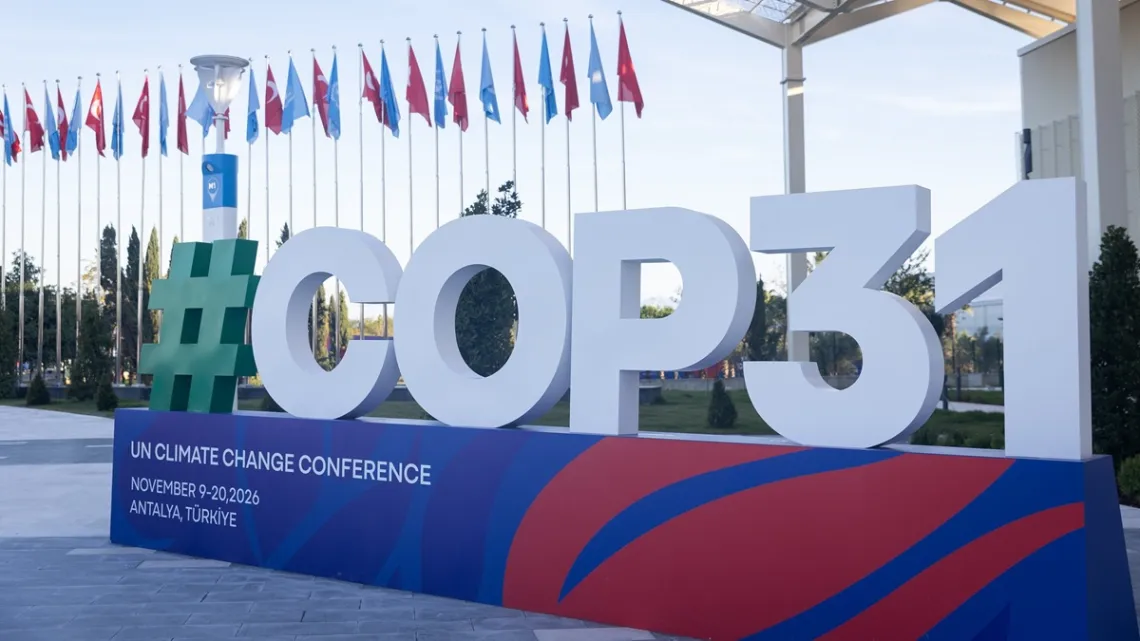
Leaders at the 31st United Nations Climate Change Conference (COP31) have called for urgent and accelerated global action to tackle rising temperatures, global warming and the growing threat of climate-related disasters.
They warned that climate change poses serious threats to human lives, livelihoods and the global economy, urging governments to prioritise environmental action despite competing international challenges, including wars, rising inflation and the rapid development of artificial intelligence (AI).
Speaking at the opening of the two-week conference on Turkey’s Mediterranean coast, UN Climate Change Executive Secretary, Simon Stiell, said the world could no longer afford to delay decisive climate action.
“The urgency of this moment must drive us forward,” Stiell said in prepared remarks, while stressing that progress made so far was “nowhere near fast enough.”
Turkey’s COP31 presidency has placed a major emphasis on accelerating the electrification of the global economy, setting a target of electrifying more than one-third of the world’s economy by 2035.
The country is seeking international support for the initiative, which is expected to reduce greenhouse gas emissions by accelerating the transition from fossil fuel-powered vehicles, heating systems, cooking equipment and other carbon-intensive technologies.
COP31 President, Murat Kurum, said the conference was designed to ensure that climate commitments translate into tangible improvements in people’s everyday lives.
“We want people to feel the results of climate talks in daily life: in buildings that use less energy, in clean public transport, in energy they can afford and in new jobs,” Kurum said.
However, geopolitical tensions and conflicts have continued to complicate global efforts to reduce dependence on fossil fuels.
The war involving Iran, now in its ninth month, has severely disrupted oil shipments through the strategically important Strait of Hormuz, triggering higher fuel prices worldwide and forcing countries to seek alternative energy supplies.
Similarly, Russia’s invasion of Ukraine and subsequent international sanctions on Moscow’s energy exports have exposed the vulnerability of countries heavily dependent on fossil fuels.
The disruptions have also strengthened arguments among some governments for maintaining or expanding domestic oil, gas and coal production.
The administration of US President Donald Trump, which is staying away from international climate negotiations for the second consecutive year, has continued to promote increased fossil fuel production as a response to energy supply challenges.
Several Asian countries, including South Korea, India and Thailand, have also increased their reliance on coal or taken measures to expand coal-fired electricity generation.
John Holdren, a Harvard University professor and former science adviser to President Barack Obama, observed that the prevailing energy crisis had emboldened advocates of fossil fuels.
“A lot of people who previously might have been embarrassed to argue for continuing very high use of fossil fuel are now feeling empowered to make that case,” he said.
Despite the renewed focus on fossil fuels, renewable energy deployment has continued to expand, largely driven by China’s growing exports of affordable clean-energy technologies.
Stiell maintained that renewable energy offered the most sustainable solution to global energy security challenges, arguing that dependence on fossil fuels had exposed economies to severe price shocks.
He said, “This year’s fossil fuel cost chaos has delivered a global shockwave, hitting households hard and spreading inflation like a cancer.
“But the solutions are clear,” he added, noting that renewable energy installations had saved the global economy hundreds of billions of dollars.
Meanwhile, the rapid expansion of artificial intelligence is emerging as another major challenge for climate action, with the growing energy demands of data centres and other AI infrastructure contributing to increased electricity consumption and greenhouse gas emissions.
In response, Turkey is expected to urge governments, businesses and other institutions participating in COP31 to adopt principles that will ensure the responsible and sustainable development and deployment of artificial intelligence.
Australia’s president of COP31 negotiations, Chris Bowen, expressed hope that the conference would demonstrate the continued relevance of international cooperation in addressing global challenges.
“Paris is working,” he said, referring to the landmark 2015 Paris Agreement on climate change. “But we must move faster.”

