


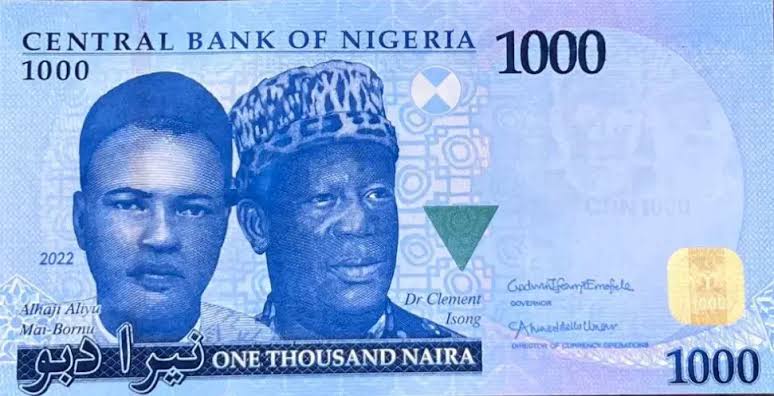
In the bustling grains markets of Borno State, where farmers, traders and middlemen converge to exchange cash for maize, rice and other commodities, a new threat is quietly undermining business: alleged counterfeit N1,000 notes.
Traders at the Kwaya Kusar Grains Market in Kwaya Kusar Local Government Area say the circulation of fake currency has become a growing concern, with some claiming to have received counterfeit notes without detecting them until they were far from the point of transaction.
The concern, according to traders who spoke to the News Agency of Nigeria (NAN), extends beyond Kwaya Kusar to markets in Biu and Bayo LGAs, where traders regularly travel to purchase commodities according to the different market days.
For a community whose economic activity depends heavily on cash transactions, the alleged circulation of counterfeit notes is more than an inconvenience. It threatens profits, creates suspicion between buyers and sellers and could undermine confidence in local markets.
For Malam Ibrahim Yusuf, a grain trader from Gombe Main Market, the problem has already translated into direct financial losses.
Yusuf said he was twice a victim of suspected counterfeit currency, recounting how he received four fake N1,000 notes about three weeks ago after buying bags of maize at Biu Grain Market.
“About three weeks ago, I went to Biu grain market to buy some bags of maize, and I was given four pieces of fake N1,000 notes, and I didn’t realise until I was in transit,” he said.
His suspicion was triggered by the feel of one of the notes.
“It was when I was about to pay the driver that I saw one new N1,000 note that was very light and felt unusual in my hand, and I suspected it was fake.”
A subsequent check revealed three additional suspected counterfeit N1,000 notes among the cash he had received.
For a trader operating on a narrow profit margin, the loss was significant.
“My profit is not much, as I make between N3,000 and N4,000 per bag after taking out transportation cost,” Yusuf said.
After purchasing three bags, he expected to make roughly N12,000. Instead, the suspected counterfeit notes immediately wiped out a substantial portion of his anticipated profit.
His experience captures the vulnerability of small traders who operate on tight margins and may not have the equipment or expertise to authenticate every note that changes hands.
Yusuf is calling for urgent intervention, including visits by relevant authorities to markets in Biu, Kwaya Kusar and Shani, to identify the source of the suspected counterfeit notes and remove them from circulation.
The timing, he argued, makes the matter even more pressing as farmers begin harvesting their crops.
“This is highly imperative, especially now that farmers have started harvesting their produce, which will surely increase the volume of trade in the markets,” he said.
Another trader, Alhaji Hassan Mai-Dawa, said he encountered a similar problem after collecting suspected counterfeit N1,000 notes from a Point-of-Sale operator in Kwaya Kusar.
He only discovered the problem when he attempted to deposit the money at a bank.
The situation is particularly challenging because many traders in the area do not accept transfers, forcing buyers to rely on cash withdrawn through POS operators.
“I think this is something the government should come in because I also faced similar issues in Biu market,” Mai-Dawa said.
He added that some traders were unable to distinguish counterfeit notes from genuine ones and could unknowingly pass the suspected fake currency on to others.
That lack of awareness has created another dimension to the problem: a trader who unknowingly accepts a counterfeit note can become the next person to suffer a loss when the note is detected.
For Mrs Hauwa Aminu, a rice trader, unusual-looking N1,000 notes had become familiar enough that she sometimes noticed them in her cash without taking immediate action.
She recalled an incident that nearly resulted in a confrontation with a customer who returned to her shop seeking a refund.
Aminu said she handed him some of the cash in her possession, only for the customer to reject some of the notes.
“I gave him the cash I had, and he rejected some of the notes, but I insisted that I am not the one printing them,” she said.
The argument left both parties dissatisfied and, according to Aminu, permanently damaged the relationship.
“It was an intense argument, and since then, that buyer never came back to my shop to buy from me,” she said.
The incident illustrates how counterfeit currency can inflict damage beyond monetary losses. It can create mistrust in communities where traders depend on repeat customers and personal relationships to sustain their businesses.
Several other traders, who spoke without revealing their identities, said they had experienced similar difficulties but were unable to determine which notes were counterfeit.
Their concern points to what may be one of the most immediate solutions: public education.
The traders are calling for widespread sensitisation in rural and semi-urban markets to help them identify suspicious notes before accepting them.
They also want authorities to intensify monitoring of markets and take action against those responsible for introducing counterfeit currency into circulation.
For Borno’s rural trading communities, where agricultural harvests are expected to increase commercial activity, the issue carries wider economic implications.
If traders become reluctant to accept cash or begin scrutinising every transaction with suspicion, the speed and ease of commerce could suffer. Small traders, who have little financial cushion to absorb losses, may bear the greatest burden.
The alleged counterfeit currency problem therefore goes beyond a few suspicious notes. It touches on trust, livelihoods and the fragile economics of rural commerce.
As the harvest season gathers momentum, traders want authorities to move quickly — not only to identify the source of the suspected counterfeit notes, but also to equip ordinary market participants with the knowledge to protect themselves.
For the traders of Kwaya Kusar, Biu and neighbouring markets, the message is simple: a market can only thrive when buyers and sellers have confidence that the money changing hands is genuine.
