


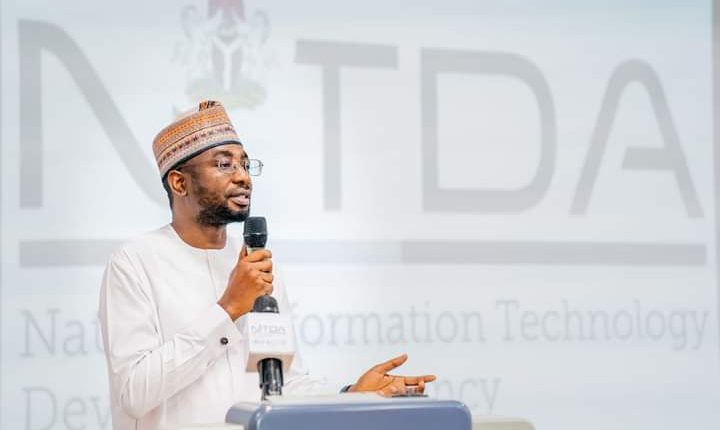
The National Information Technology Development Agency (NITDA) has commenced a five-day Executive and Technical IPv6 Migration Workshop for Ministries, Departments and Agencies (MDAs), as part of efforts to strengthen Nigeria’s digital infrastructure and accelerate the country’s digital transformation agenda.
The workshop, organised in collaboration with the Nigeria IPv6 Council and the African Network Information Centre (AFRINIC), is designed to equip government officials with the technical skills and certification required to support the transition to Internet Protocol version 6 (IPv6).
Speaking at the opening of the workshop in Abuja, the Director-General of NITDA, Kashifu Inuwa Abdullahi, represented by the Director of Digital Development Services, Mr. Oladejo Olawumi, described the participants as the first set of government officials to undergo the specialised training, stressing that their involvement was critical to the successful implementation of the country’s digital transformation initiatives.
He said the transition to IPv6 would be difficult to achieve without the active participation and technical preparedness of government institutions.
“Without this, we cannot achieve digital transformation. Without having you on board, we cannot have that transition, proper transition,” Inuwa said.
The NITDA chief explained that the training was organised to ensure that participants acquired the requisite skills and professional certification to support IPv6 adoption within their respective MDAs.
According to him, the certification would not only enhance their performance in public service but also provide them with globally recognised professional qualifications that could expand their career opportunities.
He added that the agency had arranged experienced trainers to deliver the programme, highlighting the expertise of the lead trainer, Muhammed Rudman, a former president of the Nigeria Internet Registration Association (NiRA) and chairman of the Nigerian IPv6 Council.
Inuwa emphasised the importance of building the capacity of government personnel to ensure that the migration to IPv6 was properly implemented across public institutions.
Earlier, Rudman, who is also the Chief Executive Officer of the Internet Exchange Point of Nigeria (IXPN), explained that IPv6 adoption had become increasingly important to the efficient operation and future growth of Nigeria’s internet infrastructure.
He described IXPN as a physical interconnection point for networks operating in Nigeria, with a presence in Abuja, Lagos, Port Harcourt and other cities, enabling internet service providers and major content providers to exchange traffic locally.
According to him, the exchange has helped to keep a significant proportion of internet traffic within Nigeria, reducing the need for such traffic to travel through international networks before reaching local users.
Rudman said between 50 and 70 per cent of internet traffic was now being domesticated in Nigeria through the development of local interconnection infrastructure.
He explained that the growing demands on internet infrastructure and the exhaustion of available IPv4 address resources had made the adoption of IPv6 increasingly necessary.
IPv6, the latest version of the Internet Protocol, provides a vastly larger address space than its predecessor, IPv4, allowing more devices, networks and digital services to connect to the internet as demand continues to expand.
Rudman disclosed that he and other stakeholders had spent about 15 years advocating IPv6 adoption and conducting training programmes to prepare Nigeria’s internet ecosystem for the transition.
He noted that a similar training programme had been organised in Lagos the previous week for major technical companies, describing NITDA’s initiative as an important step towards extending IPv6 adoption efforts to government institutions.
“This is the first time I’m seeing government agencies really waking up, trying to push for IP version six adoption,” he said, while commending NITDA for collaborating with industry stakeholders to drive the initiative.
The IXPN chief urged participants to actively engage with the trainers, ask questions and take full advantage of the programme, regardless of their professional backgrounds or levels of expertise.
He stressed that government officials had a significant role to play in ensuring that their respective institutions were adequately prepared for the transition.
Rudman added that the Nigeria IPv6 Council was committed to working with public institutions and other stakeholders to promote awareness, build technical capacity and facilitate the adoption of IPv6 across the country.
The workshop forms part of broader efforts to strengthen Nigeria’s digital infrastructure, improve network efficiency and prepare public institutions for the growing demands of digital government services.
Through the collaboration, NITDA and its partners are seeking to ensure that government personnel possess the expertise required to support the transition to IPv6 and contribute to the development of a more scalable, resilient and digitally enabled public sector.
