


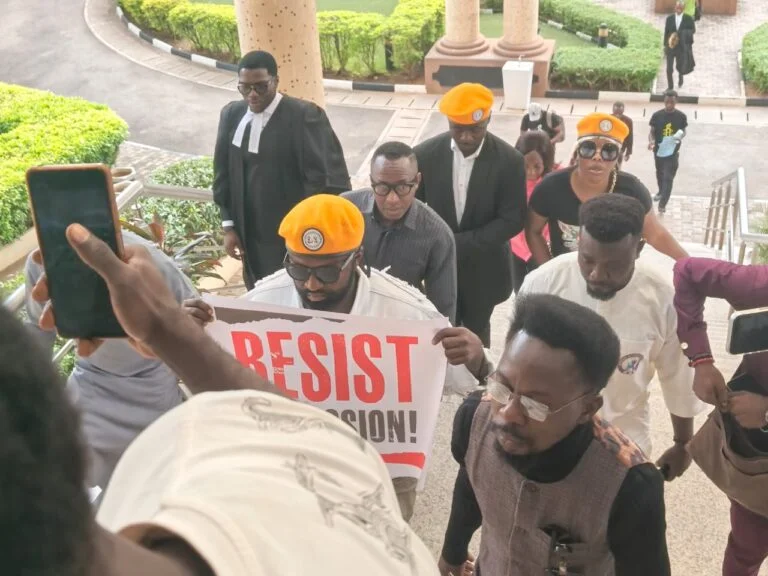
The premises of the Federal High Court in Abuja witnessed a dramatic scene on Monday as activist, politician, and publisher of Sahara Reporters, Omoyele Sowore, arrived for his trial days after a bench warrant was issued for his arrest.
Sowore, the presidential candidate of the African Action Congress (AAC) in the 2023 general election, entered the court complex accompanied by supporters carrying placards and chanting messages of solidarity. The atmosphere reflected both the political significance of the case and the enduring support the activist commands among his followers.
His appearance comes barely a week after Justice Mohammed Umar revoked the bail earlier granted to him over his failure to appear in court for the continuation of his trial. In a ruling delivered on June 16, the judge also approved an oral application by counsel to the Department of State Services (DSS), Akinkolu Kehinde (SAN), and subsequently issued a bench warrant for Sowore’s arrest.
The DSS is prosecuting Sowore over allegations that he made defamatory statements against President Bola Tinubu. The charges stem from posts published on his X (formerly Twitter) and Facebook accounts in which he allegedly referred to the President as “a criminal.”
The case has attracted widespread public attention, given Sowore’s long-standing reputation as a vocal government critic, human rights advocate, and opposition politician. His supporters view the trial as a test of free speech and democratic accountability, while prosecutors maintain that the matter concerns the protection of individual reputation and adherence to the law.
As journalists, lawyers, and supporters gathered inside and outside the courtroom, proceedings had yet to commence at the time of filing this report. Observers are expected to closely monitor developments in what has become one of the country’s most closely watched legal and political cases.
The outcome of the proceedings could have implications not only for Sowore but also for ongoing debates surrounding freedom of expression, political dissent, and the limits of public commentary in Nigeria’s democratic space.
