


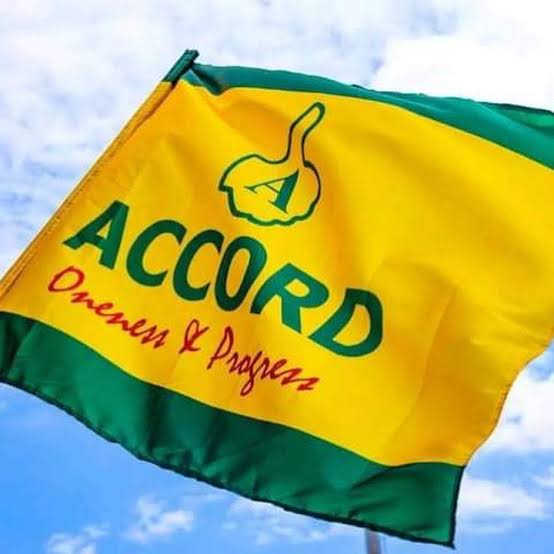
The legal battle over the future of some of Nigeria’s political parties has taken a new turn as the Accord Party in Oyo State rejected a Federal High Court judgment ordering its deregistration, insisting that it remains a viable political platform with elected representatives across the country.
The ruling, delivered by Justice Peter Lifu of the Federal High Court in Abuja, directed the Independent National Electoral Commission (INEC) to deregister five political parties — Accord, the African Democratic Congress (ADC), Action Alliance (AA), Allied Peoples Party (APP), and Zenith Labour Party (ZLP) — for allegedly failing to meet constitutional requirements on electoral performance.
The judgment stemmed from a suit filed by the Incorporated Trustees of the National Forum of Former Legislators, which argued that the affected parties did not secure the minimum electoral threshold stipulated by law.
However, the Accord Party has strongly challenged the basis of the ruling, arguing that its electoral presence and representation at various levels of government make its inclusion among the deregistered parties questionable.
Speaking in Ibadan, the party’s Secretary in Oyo State, Hon. Olayinka Dairo, described the judgment as inconsistent with the realities on the ground.
According to him, Accord remains an active political party with elected officials serving in public offices, particularly at the local government level.
“We have elected representatives, including councillors, currently serving. That is why we find it difficult to understand why Accord was listed among the parties to be deregistered,” Dairo said.
He maintained that the party has not only participated actively in elections but has also secured victories that demonstrate its continued relevance in Nigeria’s political landscape.
For the party, the court’s decision represents more than a legal setback; it raises broader questions about the criteria being used to determine the survival of political parties in a multi-party democracy.
Determined to challenge the verdict, Accord has already approached the Court of Appeal, seeking to overturn the ruling and preserve its legal status.
“We have filed our appeal in Abuja and will also seek a stay of execution pending the determination of the appeal. We anticipated this possibility and prepared for it,” Dairo stated.
The development has sparked renewed debate about political inclusion, electoral reforms and the future of smaller political parties in Nigeria. While major parties continue to dominate the electoral landscape, smaller parties argue that they remain important vehicles for political participation, grassroots representation and democratic choice.
Political observers note that the outcome of the appeal could have far-reaching implications, not only for the affected parties but also for Nigeria’s broader democratic system. A successful appeal may reaffirm the rights of smaller parties to compete and grow within the political space, while an affirmation of the judgment could significantly reshape the country’s party structure ahead of future elections.
For now, Accord Party leaders remain confident that the appellate court will reverse the ruling, insisting that their electoral achievements and continued presence in public office provide sufficient grounds for the party’s survival.
As the legal process unfolds, the controversy is expected to remain a key talking point in Nigeria’s evolving democratic journey, highlighting the delicate balance between electoral regulations and the constitutional right to political association.
