

Between Triumph and Tension: Tinubu’s Democracy Day Message Praises Progress, But Nigeria’s Hard Realities Linger

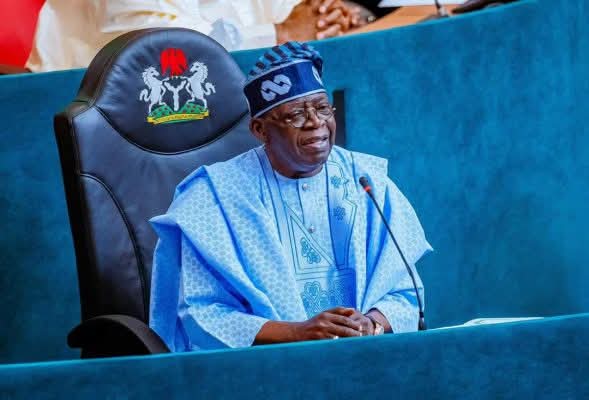
President Bola Ahmed Tinubu used Nigeria’s 2026 Democracy Day address to project a narrative of democratic resilience and reform, celebrating 27 years of uninterrupted civilian rule in Nigeria, while acknowledging—at least implicitly—that the country still wrestles with insecurity, economic hardship, and public trust deficits.
Delivering a wide-ranging national broadcast on Friday, Tinubu framed Nigeria’s post-1999 democratic era as historic, insisting it represents the “longest stretch of civilian rule” in the nation’s history. Yet beneath the celebratory tone lay a recurring tension: a government asserting progress in governance and security, while millions of citizens continue to experience inflation, violence, and uncertainty.
Democracy Celebrated, But Trust Still Fragile
With elections approaching in Ekiti State and Osun State, the President placed significant emphasis on electoral credibility, urging the Independent National Electoral Commission, security agencies, and political actors to safeguard the integrity of the process.
His warning—that democracy fails when citizens lose faith in elections—reflected a broader concern that Nigeria’s democratic legitimacy remains unevenly contested, particularly at the grassroots where voter apathy and distrust persist.
Security Claims vs Ground Realities
Tinubu devoted a large portion of his speech to security, describing expanded military operations, recruitment drives, and record budget allocations, including a ₦5.41 trillion defence package.
He reported major battlefield successes against extremist groups in the North-East, including the degradation of ISWAP infrastructure in Borno State, and claimed significant reductions in terror-related deaths.
However, the address came against the backdrop of recent abductions in Oyo State and Borno State—a reminder that despite official statistics, insecurity remains deeply embedded in multiple regions.
His stark ultimatum to armed groups—“surrender or face the full force of the Nigerian State”—underscored a hardening security posture, even as analysts continue to debate whether military pressure alone can resolve Nigeria’s complex internal conflicts.
Economic Reform: Gains on Paper, Pain on the Ground
On the economy, Tinubu defended sweeping reforms introduced since 2023, arguing they have restored fiscal stability, improved revenues, and renewed investor confidence across key sectors such as agriculture, manufacturing, and energy.
He highlighted structural changes in the power sector, referencing the Electricity Act (Nigeria) reform, which decentralised electricity regulation and opened the door for subnational governments to participate in energy markets.
But his own admission that “many Nigerians still face economic hardship” cut against the broader optimism of reform gains, underscoring the persistent gap between macroeconomic indicators and lived realities. Inflation, unemployment, and cost-of-living pressures remain central to public frustration.
His now-familiar refrain—that “democracy must be felt in the pocket”—captured this contradiction: a government claiming progress while acknowledging that the benefits are not yet widely felt.
Memory Politics and National Symbolism
The speech also leaned heavily on historical symbolism, with Tinubu revisiting the legacy of the June 12 struggle and honouring figures such as M.K.O. Abiola, Kudirat Abiola, Gani Fawehinmi, and other pro-democracy icons.
By foregrounding these figures, the President positioned his administration within a continuum of democratic sacrifice and struggle. Yet critics might argue that such commemorations increasingly serve as symbolic reinforcement of legitimacy, even as present-day governance challenges persist.
Security Emergency and Centralised Response
Tinubu’s announcement of expanded recruitment—over 50,000 police officers and additional military personnel—alongside massive defence spending, reflects a state leaning more heavily into coercive capacity.
The scale of investment signals urgency, but also raises questions about sustainability and effectiveness, particularly given longstanding structural weaknesses in policing and intelligence coordination.
Local Governance and Political Control
Another notable theme was the push for financial autonomy for Nigeria’s 774 local councils. While framed as a democratic reform aimed at improving grassroots governance, it also signals an ongoing restructuring of power distribution within the federation.
Critics have long argued that weak local government systems contribute to insecurity and poor service delivery. Whether the current reforms will translate into genuine decentralisation—or tighter federal oversight through funding mechanisms—remains to be seen.
A Nation at the Crossroads
Tinubu closed his address with a message of unity, insisting that Nigeria’s diversity remains its strength and urging citizens to reject division and despair. Yet the subtext of the speech was harder to ignore: a nation still balancing on the edge between reform optimism and everyday hardship.
His assertion that Nigerians “do not break” may resonate as national rhetoric, but the lived experience of insecurity, inflation, and institutional distrust continues to test that claim.
In the end, the 2026 Democracy Day address stood as both celebration and contradiction—an account of progress that acknowledges its own incompleteness, and a reminder that Nigeria’s democratic journey remains unfinished.
