


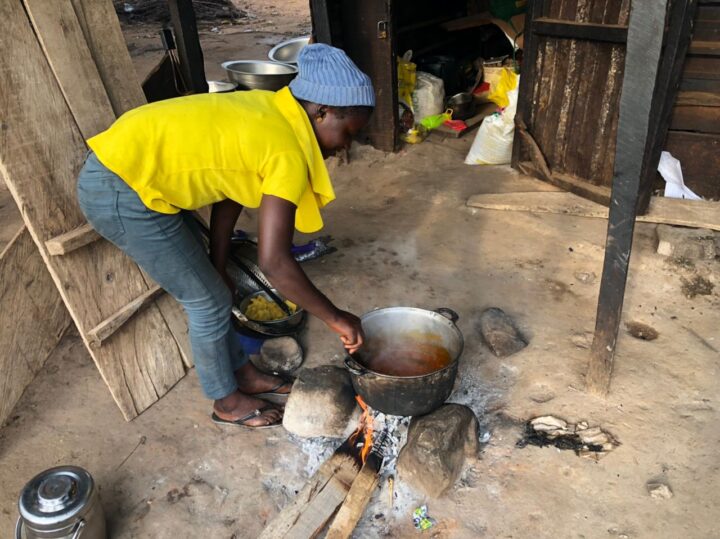
For many households in the Federal Capital Territory (FCT), the kitchen has become another front in the struggle to cope with rising living costs.
Once regarded as a cleaner, faster and more convenient alternative to traditional cooking fuels, Liquefied Petroleum Gas (LPG), popularly known as cooking gas, is increasingly becoming expensive for ordinary households. As a result, some residents are returning to firewood and charcoal, while others are combining different fuels to keep their cooking fires burning.
Residents who spoke to the News Agency of Nigeria (NAN) in Abuja said the price of cooking gas, currently ranging from about ₦1,380 to ₦2,000 per kilogramme in some locations, has made it difficult for low- and middle-income households to rely exclusively on LPG.
For some families, the solution is not to abandon gas completely but to ration its use by combining it with cheaper alternatives.
Mrs Asisat Yunusa, a resident, said she currently buys a kilogramme of cooking gas for about ₦1,500, with the quantity lasting approximately five days.
According to her, two kilogrammes can last between one and two weeks, depending on how frequently the household cooks.
She, however, observed that gas bought from filling stations tends to last longer than the same quantity purchased from black-market vendors.
For Miss Sherifat Bello, charcoal has become a useful companion to cooking gas because of its accessibility.
Bello said a kilogramme of gas that previously cost about ₦1,400 now sells for around ₦1,700 at some black-market outlets. The quantity, she said, lasts only three to four days when purchased from such vendors, compared with up to a week when bought from a filling station.
The growing dependence on traditional fuels is also reflected in the charcoal and firewood trade.
A survey by NAN showed that a bag of charcoal sells for between ₦10,000 and ₦15,000, while a mini-truck load of firewood costs between ₦10,000 and ₦13,000.
Mrs Grace Ameh, a firewood seller, said she buys firewood in bulk for about ₦85,000 and sells five pieces for ₦1,000.
Although she could not say whether firewood or gas currently enjoys greater patronage, Ameh said residents’ choices were largely influenced by affordability and familiarity.
“Some people are used to gas and some are used to firewood,” she said.
For Ameh, the return to firewood is less a matter of preference than necessity.
She acknowledged that cooking with gas was easier and cleaner but said the availability of firewood in her neighbourhood provided an alternative for residents struggling to afford LPG.
“Gas is stressless and better than firewood, but I don’t have a choice,” she said.
Similarly, Mrs Ngozi Okeke, a charcoal vendor and resident, said the charcoal business was no longer as lucrative as it used to be, partly because households now have several cooking options.
She attributed some of the demand for charcoal to the scarcity of kerosene, while noting that charcoal prices also fluctuate according to the cost incurred by vendors.
Okeke said traders sometimes reduce the quantity sold in order to protect their profit margins.
She recalled that a bag of charcoal sold for between ₦3,000 and ₦4,500 about four years ago, but now costs between ₦9,000 and ₦10,000 in some places.
For Mr Paul Ibe, a taxi driver, the choice of cooking fuel has increasingly become a question of cost and accessibility.
He said while LPG offered greater convenience and produced less smoke, the high price and the distance to some gas filling stations were forcing some households to rely on firewood and charcoal.
The situation highlights the difficult choices facing families as they try to balance affordability, convenience and cleaner cooking.
While LPG remains the preferred option for many households because of its speed and relatively cleaner combustion, its rising cost is making exclusive dependence on it increasingly difficult for some residents.
The use of firewood and charcoal, however, comes with its own challenges, particularly exposure to smoke and the environmental consequences associated with excessive dependence on traditional biomass fuels.
For residents already struggling with the rising cost of food and other essentials, however, the immediate priority remains finding a way to prepare meals without exhausting their household budgets.
Ibe therefore called for more affordable and accessible cooking fuel options to reduce the financial burden on households and enable more Nigerians to embrace cleaner cooking methods.
For many Abuja families, the debate is no longer simply about whether gas, charcoal or firewood is the better fuel.
It is about which one they can afford to use tomorrow.
