


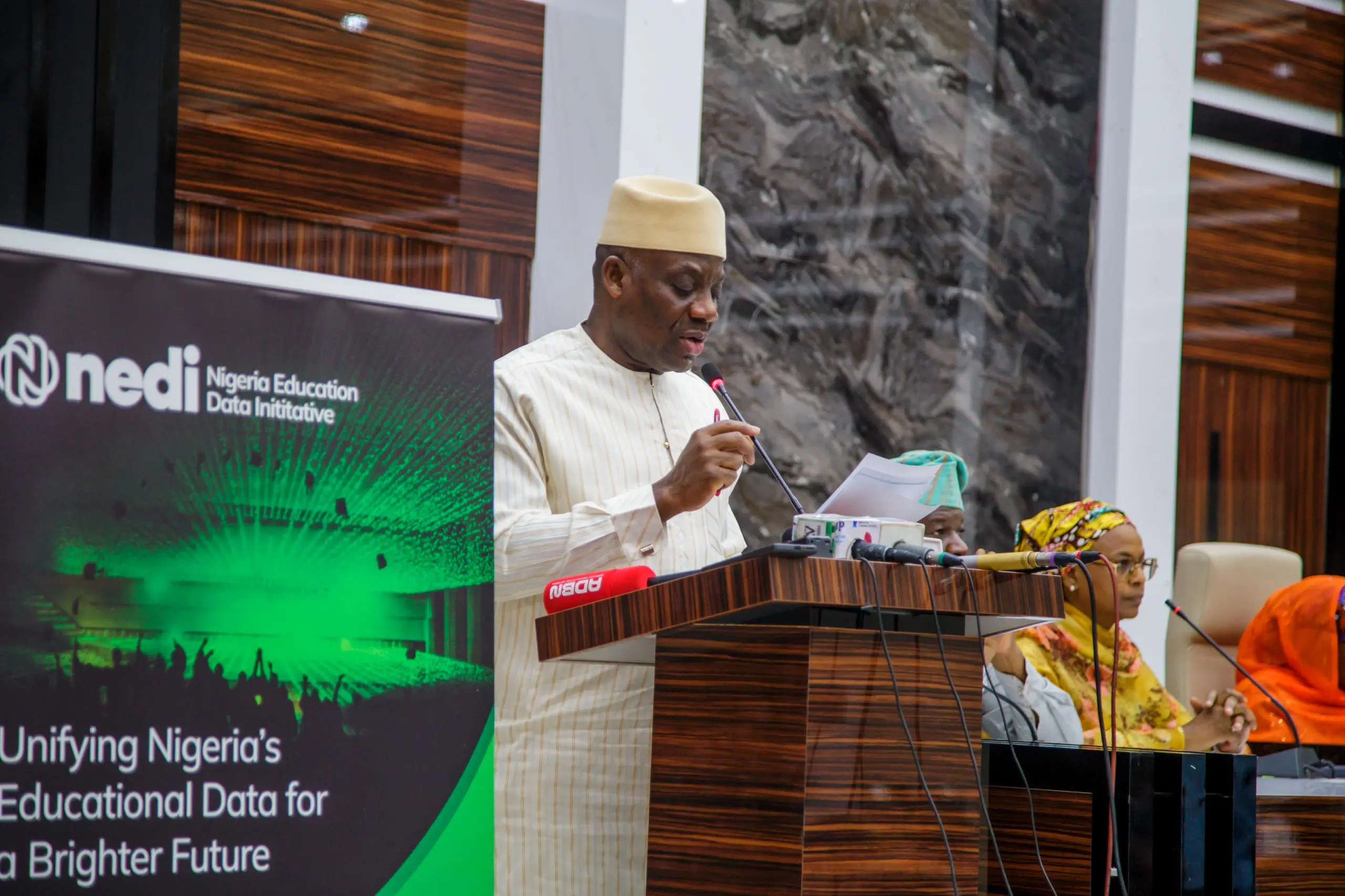
The Federal Ministry of Education’s plan to launch a Digital National Education Management Information System (DNEMIS) on July 1 signals a significant shift in how Nigeria intends to govern, fund and plan its education sector — with data now positioned at the centre of reform efforts.
At a news conference in Abuja, the National Project Coordinator of the Special Programmes Operations and Implementation Unit (SPOIU), Office of the Minister of Education, Mr Adebayo Onigbanjo, described the initiative as a cornerstone of the broader Nigeria Education Sector Renewal Initiative (NESRI), being driven under the leadership of the Minister of Education, Dr Tunji Alausa.
Beyond the language of digital transformation, the initiative reflects an attempt to correct long-standing structural weaknesses in education planning. According to ministry officials, Nigeria’s education system has for years operated on fragmented data systems, inconsistent reporting mechanisms and delayed access to reliable statistics — gaps that have hindered accountability and weakened policy responses.
Onigbanjo said the government is now treating education data as a strategic asset rather than an administrative afterthought.
“For many years, education planning and administration relied on fragmented systems, inconsistent reporting processes and limited access to reliable and timely data.
“These challenges constrained effective planning, weakened accountability and limited the sector’s ability to respond to emerging realities,” he said.
To address these gaps, the ministry developed the Nigeria Education Data Infrastructure (NEDI), a framework designed to harmonise and standardise data collection across all levels of education. DNEMIS, officials explained, is the flagship platform within this structure, intended to serve as the operational hub for planning, budgeting, monitoring and evaluation.
The system is expected to capture data on learners, schools, teachers and education investments in a unified database — a move officials believe will strengthen evidence-based decision-making in a sector often criticised for weak data integrity.
“The progress recorded through NEDI and the implementation of DNEMIS reflects the ministry’s broader commitment to ensuring that reforms are not only announced but effectively coordinated, implemented and measured.
“Data is no longer a back-office function. It is becoming the engine of education reform in Nigeria,” Onigbanjo said.
The digital transition also carries implications for transparency and public engagement. Ms Mojoyin Adebajo, Special Assistant to the Minister on Digital Communications and E-Learning, said DNEMIS will digitise the Annual School Census and, for the first time, make selected education data publicly accessible through an interactive portal.
“This represents an important step towards expanding access to information and encouraging broader participation in conversations that shape the future of education in Nigeria,” she said.
The platform is expected to be used not only by government agencies but also by researchers, civil society groups, development partners, the private sector and journalists — a development that could reshape how education performance is tracked and debated publicly.
Officials also emphasised safeguards around data privacy. The NEDI Coordinator, Abubakar Isah, said the ministry has taken steps to ensure compliance with Nigeria’s data protection laws, a critical consideration as the system consolidates sensitive education records nationwide.
International partners are also closely watching the rollout. UNICEF Education Specialist for Planning, Monitoring, Data and Research, Saka Ibraheem, said the long-term goal is integration across multiple fragmented systems currently in use.
“Before next year, we hope to have the Education Management Information System (EMIS), Teacher Management Information System (TMIS) and individual learner records in one system.
“One system for education and one system for Nigeria,” he said.
He added that the integrated platform would assign unique identifiers to learners, making it possible to track enrolment patterns and identify out-of-school children more efficiently — a step seen as crucial in addressing Nigeria’s persistent school dropout and access challenges.
If successfully implemented, DNEMIS could mark one of the most ambitious attempts yet to digitise education governance in Nigeria. But its effectiveness will ultimately depend not only on technology, but on sustained coordination across federal, state and local education systems — and the political will to ensure data is consistently collected, updated and used in decision-making.
