


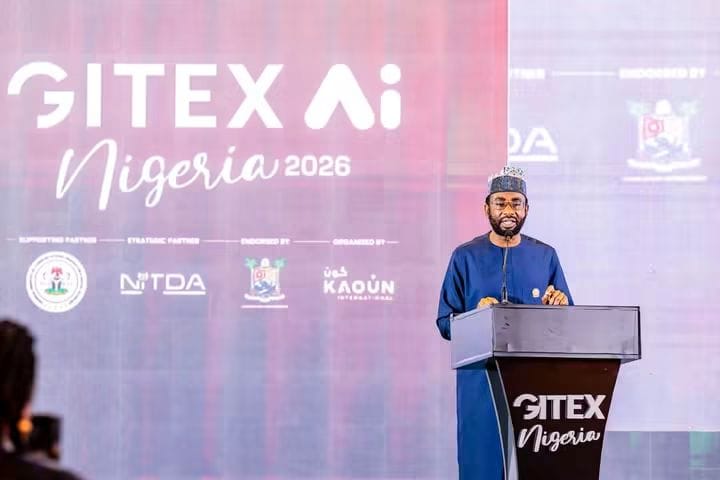
Nigeria’s quest for technological independence is entering a new phase, with the Federal Government, National Assembly and Lagos State Government moving to strengthen domestic control over the infrastructure, data and technologies powering the country’s rapidly expanding digital economy.
The emerging strategy, unveiled at the opening of GITEX Nigeria 2026 in Abuja, suggests that Nigeria’s digital transformation is no longer being viewed merely as a question of connectivity and access, but increasingly as an issue of economic power, national security and strategic autonomy.
At the centre of the debate is artificial intelligence, which stakeholders said could determine the country’s competitiveness and ability to protect critical national interests in the years ahead.
The Director-General of the National Information Technology Development Agency (NITDA), Kashifu Inuwa Abdullahi, warned that Nigeria could not achieve meaningful digital independence if the critical infrastructure on which its AI ecosystem depends remained largely controlled from outside the country.
Abdullahi argued that AI should be treated as strategic national infrastructure rather than simply another emerging technology, given its growing influence on government, finance, healthcare, education, security and other sectors.
He said Nigeria needed to develop what he termed “digital self-determination”, stressing that AI sovereignty must extend beyond ownership of AI models to encompass connectivity, computing capacity, data centres, cloud infrastructure, algorithms, data governance, operational control and appropriate legal frameworks.
The NITDA chief challenged Nigerian technology companies to move beyond consuming foreign-developed AI solutions and begin developing indigenous algorithms and applications capable of addressing the country’s peculiar challenges.
He also drew attention to the strategic importance of data, warning that the quality and ownership of data would increasingly determine the effectiveness of AI systems.
“We used to say AI is biased, but AI is not biased. It is the data we train the AI that is biased,” he said, stressing the need for locally generated data to ensure that AI systems understand Nigeria’s realities and serve its population effectively.
Beyond data ownership, Abdullahi raised questions about who ultimately exercises operational control over AI systems deployed in sensitive sectors and whether Nigerian laws would be capable of regulating such systems.
He warned that organisations controlling AI systems capable of influencing financial transactions, markets, healthcare and other critical services could wield significant influence over the country.
Consequently, he called for legal and regulatory safeguards to ensure that technologies deployed in Nigeria operate in accordance with national interests.
The NITDA DG pointed to Project Bridge, which seeks to deploy 90,000 kilometres of fibre-optic infrastructure, alongside efforts to strengthen cloud and data sovereignty, as part of the Federal Government’s broader attempt to build the foundation for digital independence.
The National Assembly also signalled its readiness to strengthen the legislative framework underpinning the country’s digital transformation.
The Senate Committee Chairman on ICT and Cybercrime, Senator Shuaib Afolabi Salisu, warned that technological dependence could expose Nigeria to significant national security risks.
Salisu said sovereign AI was not merely a technology-sector issue but one directly connected to Nigeria’s security, economy and collective wellbeing.
He cautioned that digitising government and other critical sectors without sufficient control over the underlying infrastructure could leave sensitive national data in the hands of foreign entities.
According to him, the National Assembly is working towards concluding the proposed National Digital Economy and Governance Bill, which is expected to establish a broader framework for digital technology deployment and improve coordination among government institutions.
The proposed legislation, he said, would also introduce regulatory sandboxes for emerging technologies such as AI, enabling authorities to test new technologies before allowing wider deployment.
Salisu further disclosed plans to review and replace existing cybercrime legislation to address new forms of cyber threats, including online child abuse.
He described an ungoverned cyberspace as potentially more dangerous than an ungoverned physical space because criminals can operate across borders and from virtually anywhere in the world.
The senator also urged multinational technology companies operating in Nigeria to respect and comply with the country’s laws and regulatory requirements.
For the Federal Government, however, achieving digital sovereignty will require more than legislation and infrastructure. It will also depend on developing a large pool of Nigerians capable of designing, deploying and managing advanced technologies.
Representing the Secretary to the Government of the Federation, Senator George Akume, the Permanent Secretary, Political and Economic Affairs Office, Mrs. Bekearedebo Augusta Warrens, said the administration was laying the groundwork for Nigeria to move from being a consumer of technology to becoming a producer and exporter of digital solutions.
She said the administration had prioritised digital identity, connectivity, technical skills, cloud infrastructure and data sovereignty as components of its digital transformation agenda.
She cited the 3 Million Technical Talent programme, which has recorded 1.87 million registrations across the 774 local government areas, with more than 125,000 Nigerians trained through three cohorts.
The programme, she said, is equipping Nigerians with skills in artificial intelligence, cloud computing, cybersecurity and software engineering.
The Federal Government is also targeting a massive expansion of digital infrastructure through its proposed 90,000-kilometre fibre-optic network, which is expected to extend connectivity across states, local government areas and wards.
In the cloud sector, the National Digital Cloud Policy is targeting $750 million in private investment in cloud and data infrastructure within 24 months.
Lagos State, Nigeria’s leading technology and commercial hub, is also positioning itself as a critical part of the country’s digital infrastructure strategy.
Representing Lagos State Governor Babajide Sanwo-Olu, the Commissioner for Innovation, Science and Technology, Mr. Olatunbosun Alake, said the state had been working to create a more predictable environment for technology investors.
He said Nigeria’s investment narrative had changed considerably since 2023, arguing that investors were increasingly looking beyond the country’s challenges towards its opportunities.
“What has changed in the last three years is not our potential; it is our predictability,” he said.
Sanwo-Olu identified infrastructure, talent, rules, capital and demand as the five major pillars required for sovereign AI.
He disclosed that Lagos had laid more than 3,000 kilometres of fibre-optic cable between 2019 and 2025, while foreign investors had committed to another 30,000 kilometres of fibre ducts along major economic corridors.
He also linked the Lagos State Electricity Law to the growing interest of hyperscale data-centre operators in the state.
According to him, Lagos had recently commissioned a hyperscale data centre, with additional facilities expected to come on stream.
The developments point to a broader shift in Nigeria’s digital strategy.
Rather than focusing exclusively on connecting more Nigerians to the internet, the country is increasingly seeking control over the infrastructure, data, skills, capital and regulatory systems that determine how digital technologies are developed and deployed.
The GITEX Nigeria 2026 discussions therefore exposed a central challenge facing the country: Nigeria’s ability to harness the enormous opportunities presented by AI will depend not only on access to the technology, but on who owns, controls and governs the ecosystem behind it.
For Africa’s most populous nation, the emerging race for AI sovereignty is consequently becoming a race for economic relevance, national security and the power to determine its own digital future.
