


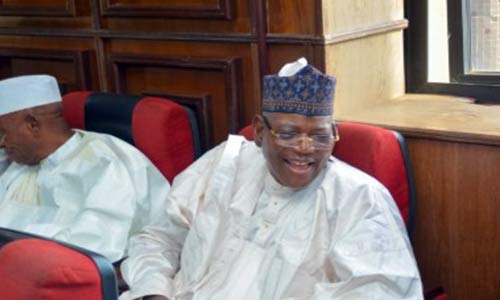
A fresh twist emerged on Tuesday in the long-running N1.35 billion money laundering trial involving former Jigawa State Governor Sule Lamido, as a courtroom disagreement erupted between the defence team and the Economic and Financial Crimes Commission (EFCC) over a subpoenaed witness presented by the anti-graft agency.
The tense exchange unfolded before Justice Ijeoma Ojukwu of the Federal High Court in Abuja shortly after proceedings resumed, highlighting growing legal contestations as the case moves into the defence stage.
Lamido is facing trial alongside his sons, Aminu and Mustapha Lamido, as well as Aminu Wada Abubakar and two companies — Bamaina Holdings Limited and Speeds International Limited — over allegations of laundering N1.35 billion. The defendants have denied the charges.
The latest controversy stemmed from an earlier application by the defence, led by senior advocate Joe Agi, seeking to compel EFCC Chairman Ola Olukoyede, or another suitable commission official, to testify after the court dismissed the defendants’ no-case submission.
The defendants had opted for a no-case submission following the close of the prosecution’s case, during which the EFCC called 17 witnesses.
When the matter came up on Tuesday, EFCC investigator Kayode Oyetunde was presented in court in response to the subpoena. However, before the witness could testify, Agi requested an adjournment to enable the defence team confer with him.
The request immediately met resistance from EFCC counsel Chile Okoroma, SAN, who argued that an adjournment was unnecessary. Instead, he urged the court to briefly stand down proceedings, noting that all documents produced by the witness had already been filed before the court.
Justice Ojukwu sided with the prosecution, refusing the application for adjournment. She warned that granting the request could result in the subpoena being struck out and instead ordered a one-hour stand-down to allow the defence interact with the witness.
But when proceedings resumed, another hurdle emerged.
Under questioning, Oyetunde disclosed that he was not a member of the investigative team that handled the case. He explained that his role was limited to locating and producing documents requested through the subpoena.
The revelation prompted an immediate objection from the defence.
Agi argued that the witness lacked firsthand knowledge of the facts in dispute and therefore could not provide meaningful testimony. He urged the court to direct the EFCC chairman to produce a witness directly connected to the investigation.
“He cannot testify on matters he knows nothing about,” the defence counsel maintained.
The EFCC, however, disagreed.
Okoroma argued that the commission, as a corporate entity, could be represented by any competent officer. He stressed that all documents requested by the defence had been produced and that the subpoena had effectively been complied with.
According to him, the defence’s objections were without merit, insisting that the court should not be persuaded by complaints over the identity of the officer presented.
Justice Ojukwu, while responding to concerns raised by the defence regarding a previous prosecution witness, advised Agi to formally apply for the witness to be recalled if further testimony was required.
The judge observed that subpoenas are generally reserved for situations where a witness declines to appear voluntarily.
In a ruling that moved proceedings forward, Justice Ojukwu admitted all the documents produced pursuant to the subpoena into evidence.
The case was subsequently adjourned until June 4 for the continuation of the defence.
The trial, which has witnessed several procedural battles and judicial reassignments, remains one of the most closely watched corruption cases involving a former state governor, with both sides now preparing for the next phase of courtroom proceedings.
