


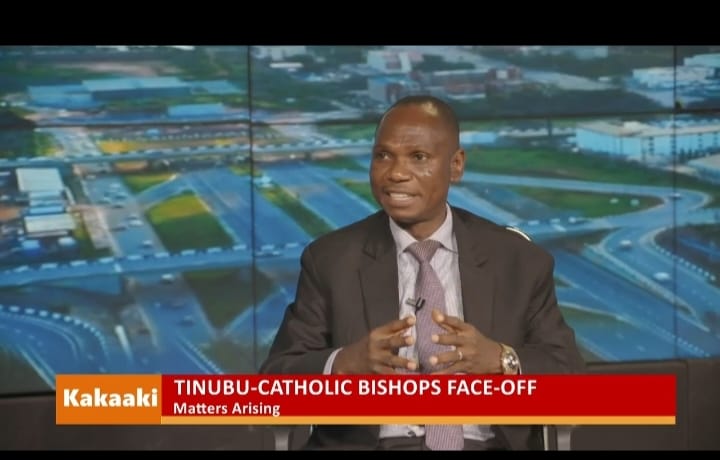
A Deputy Director-General of the All Progressives Congress (APC) Support Groups Council, Dr AK Peters, has criticised the handling of the recent meeting between President Bola Ahmed Tinubu and the Catholic Bishops Conference of Nigeria (CBCN), saying aides of the President had unnecessarily blown the disagreement out of proportion.
Peters, who is also a Knight of the Catholic Church, made the remarks while appearing on AIT’s Kakaaki programme, where he spoke on the controversy surrounding the bishops’ meeting with the President and subsequent reactions from some of the President’s aides and supporters.
He said the bishops’ visit to the President was undertaken in good faith and should not be interpreted as an attempt by the Catholic Church to antagonise the Tinubu administration.
According to him, the Catholic Church has maintained a cordial relationship with the Federal Government and has contributed significantly to the development of the country, particularly in education, healthcare and social development.
Peters noted that the cordial relationship was recently demonstrated by the visit of Bishop Paul Richard Gallagher, Secretary for Relations with States and International Organisations of the Holy See, to Nigeria.
He said Gallagher, whom he described as being equivalent to the Vatican’s Foreign Minister, was received by President Tinubu at the State House as part of activities marking 50 years of diplomatic relations between Nigeria and the Holy See.
“So when the bishops visited Mr. President, they began by appreciating the president for that cordial relationship that they have had, and for the reception he had for the Secretary of Diplomatic Relations of the Holy See in Nigeria,” he said.
Peters explained that the bishops had raised issues they believed required government attention while also acknowledging areas where they believed the administration was doing well.
He argued that President Tinubu had listened to the bishops and responded positively to some of the issues raised, but expressed disappointment that some presidential aides subsequently escalated the matter through their public comments.
“As I said, the bishops have spoken. They met Mr. President and told the president what they feel is not going so well in the country, and commended Mr. President for what they know he is already doing well. However, the handlers of Mr. President are the one who have blown this thing out of proportion,” Peters said.
He cited the issue of schools previously owned or administered by Christian missions as one area where he believed the President’s response had been misunderstood.
According to him, Tinubu told the bishops that he was pleased they had raised the issue and recalled that, as governor of Lagos State, he had returned schools to the missions.
Peters said the expected response, rather than a confrontation, should have been for the President to encourage governors of states where mission schools had not been fully returned to take appropriate steps.
The APC chieftain also warned that attempts to portray the Catholic Church as politically opposed to the administration could have serious consequences for APC members who are Catholics and have remained committed to the party and President Tinubu.
He described the Catholic Church as a major component of the Christian Association of Nigeria (CAN), stressing that many prominent members of the Tinubu administration are Catholics.
He listed the Secretary to the Government of the Federation, the President of the Senate, the Governor of the Central Bank of Nigeria, the Minister of Works, David Umahi, Imo State Governor Hope Uzodimma, Benue State Governor, Anambra State Governor Charles Soludo and the Minister of Foreign Affairs, among others, as prominent Catholics.
Peters said the implication was that antagonising the Catholic Church through inflammatory rhetoric could unnecessarily create difficulties for Catholics within the APC and the administration.
“Why should the president’s aides blow these things out of proportion instead of just leaving the things the way they are?” he asked.
Security: Government Making Efforts
Peters acknowledged that the Tinubu administration still faced serious challenges, particularly in the area of insecurity, but said it would be unfair to conclude that the government had done nothing to address the situation.
He cited the establishment of Forest Guards, the move towards state police and the expansion of Nigerian Army divisional formations as evidence of efforts by the administration to tackle the country’s security challenges.
“Take, for instance, security. The security situation has been bad. We know the government is grappling with how to handle the issue, but we also can appreciate the fact that the Forest Guards has been established by this government, for the first time we can also see that the state police, which has been advocated for, for several years, has come to be,” he said.
He added that the expansion of Army formations demonstrated what he described as “genuine and concerted efforts” to contain insecurity.
Peters, however, said the government must listen to criticisms and address areas where it had fallen short rather than becoming defensive.
He specifically criticised presidential aides Daniel Bwala and Bayo Onanuga over their handling of the controversy, saying their interventions had not helped the situation.
“I do not think I like the position of Daniel Bwala. I do not even think the elderly Bayo Onanuga has done well in handling this thing,” he said.
‘Don’t Call Cardinal Onaiyekan an Obidient’
The APC chieftain took particular exception to descriptions of retired Catholic Archbishop of Abuja, Cardinal John Onaiyekan, as an “Obidient” following his criticism of government policies.
He questioned the wisdom of reducing a respected Catholic cardinal to a political label because of his public views.
“How can you say that Cardinal Onaiyekan is an obidient? How has he demonstrated that he is an obedient? How can you reduce a Cardinal to the level of calling him an obidient?” Peters asked.
He said the reaction was capable of upsetting Catholics who support the APC and President Tinubu.
“I am a member of the APC, and there are many of us responsible members of the APC, leaders of this party, who are driving the campaign of Mr. President,” he said.
Peters maintained that APC members who are Catholics should not be placed in a difficult position by the comments of those speaking on behalf of the President.
He recalled an incident involving Senate President Godswill Akpabio, who, according to him, demonstrated the importance of listening to the counsel of church leaders.
Peters said Akpabio attended a Thanksgiving Mass in his home state in January, where a Catholic priest preached about building bridges, mending fences and forgiveness.
According to him, Akpabio subsequently announced that he had listened to the sermon and decided to withdraw charges he had earlier instituted against Senator Natasha Akpoti and others.
Peters said the episode showed that political leaders could listen to religious leaders without necessarily interpreting their counsel as political opposition.
“So we expect also that now that the bishops themselves have come and spoken, the issues that we think we should take immediately, we should listen to them and do better where we have to do better,” he said.
Calls for Pope Leo XIV to Visit Nigeria
Peters also disclosed that the Catholic bishops had urged President Tinubu to invite Pope Leo XIV to Nigeria, saying such a visit could help deepen the relationship between the Catholic Church and Nigeria.
He recalled that Nigerian government delegations had attended events in the Vatican following the election and inauguration of Pope Leo XIV, including a delegation led by the President himself.
According to him, the recent visit of the Vatican official to Nigeria was also connected with the first anniversary of Pope Leo XIV’s pontificate and the celebration of Nigeria-Vatican diplomatic relations.
Peters expressed disappointment that the President did not, in his view, directly respond to the bishops’ request for an invitation to the Pope.
“Part of what the bishops told Mr. President was that he should invite His Holiness Pope Leo XIV to Nigeria so that he can also come and be briefed on Nigeria,” he said.
He stressed that the Catholic Church remained committed to peace and national development and urged the government not to allow the controversy to damage its relationship with the Church.
“We will not want, because of this, to smear the relationship between the government and people of the Federal Republic of Nigeria. The Pope is a world leader. The Pope is a leader of peace. The Church Fathers, the members of the Catholic Bishop Conference of Nigeria, are advocates of peace,” Peters said.
‘Nigeria Must Build a Nation of Citizens’
Peters broadened his argument by warning against excessive politicisation of national issues, saying the country’s political elite should focus more on nation-building than partisan confrontation.
He said Nigeria’s problems were rooted in what he described as a failure to build a nation of citizens rather than one dominated by considerations of indigene status.
The author of nine books on leadership said he had examined the issue extensively in his 2022 book, This Ship Must Not Sink: Resolving Nigeria’s Issues.
According to him, he identified a number of factors that have continued to hinder Nigeria’s progress, including indiscipline, insincerity, injustice, intolerance and impunity.
He urged Nigerians and political leaders to embrace tolerance and reduce the level of political tension in the country.
Peters also insisted that the APC remained the most prepared political party ahead of the next general elections, describing it as the party with structures across the country.
He said the APC’s political strength and the Tinubu administration should not be unnecessarily brought into conflict with the Catholic Church.
“The All Progressive Congress seems to be the only party that is ready for the elections today. They should not carry the head of APC and the government of President Tinubu and hit them together with the Catholic Church,” he said.
Peters described the Catholic Church as “a worthy collaborator and partner for the development of Nigeria,” and urged the government and its officials to focus on constructive engagement with the bishops rather than escalating disagreements into political confrontation.
He said Nigerians were increasingly concerned about the heated political atmosphere and called on political actors to exercise restraint in their public statements.
“Nigerians at the street are not happy with what is happening,” he added.
