

Turkey Deepens Military Partnership with Somalia Amid Shifting Regional Security Dynamics

Turkey is significantly expanding its military partnership with Somalia, reinforcing its position as one of Mogadishu’s most important security allies at a time of growing uncertainty over the future of international stabilization efforts and increasing pressure from Western partners to sustain the fight against Al-Shabaab.
The latest developments point to a broader strategic realignment in Somalia’s security architecture, with Ankara deepening its involvement in the country’s defense sector through expanded military training, operational support, and institutional reforms aimed at building a self-reliant Somali National Army (SNA).
The renewed cooperation signifies Somalia’s effort to develop integrated land, air, and naval capabilities capable of independently confronting insurgent threats and securing the country’s vast territory and coastline.
Security sources familiar with the development said the Somali government has accelerated plans to build a unified defense structure operating across multiple regions, reflecting a long-term strategy to reduce dependence on foreign peacekeeping forces.
The initiative includes strengthening command structures, improving force mobility, enhancing intelligence coordination, and developing specialized units capable of responding to evolving threats posed by Al-Shabaab.
The move comes as uncertainty continues to surround the future role of the African Union Support and Stabilization Mission in Somalia (AUSSOM), which replaced the African Union Transition Mission in Somalia (ATMIS) but continues to face operational and funding challenges. Officials believe Somalia must increasingly rely on its own security institutions if recent gains against extremist groups are to be sustained.
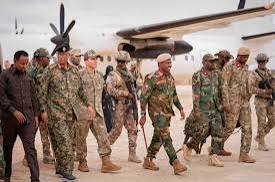
Demonstrating the growing defense relationship, Commander of the Somali National Army, Brig. Gen. Ibrahim Mohamed Mohamud, recently arrived in Baidoa alongside the Commander of TurkSom, Gen. Sebahattin Kalkan.
The joint visit is being viewed as more than a routine inspection. Military analysts say it underscores Ankara’s continued commitment to Somalia’s security sector reforms and reflects close coordination between Turkish military advisers and Somali commanders on future operational planning.
Turkey has played a central role in training thousands of Somali soldiers through the TurkSom Military Training Centre in Mogadishu, one of Ankara’s largest overseas military facilities.
The partnership has evolved beyond basic military instruction to include leadership development, logistics, force modernization, and institutional capacity building.
The renewed Turkish engagement comes against the backdrop of sustained pressure from Somalia’s Western partners to intensify military operations against Al-Shabaab.
Only days earlier, Commander of the United States Africa Command (AFRICOM), Gen. Dagvin R.M. Anderson, urged Somali authorities to maintain relentless pressure on the extremist group and prevent it from regaining territory.
His remarks reflected Washington’s continued commitment to supporting Somalia’s counterterrorism campaign through intelligence sharing, training, and precision operations against Al-Shabaab leadership.
The United States has continued to conduct targeted strikes and provide military assistance to Somali security forces, viewing Al-Shabaab as one of Africa’s most resilient jihadist organizations and a continuing regional security threat.
The evolving security environment has also pointed to the emergence of parallel defense partnerships across Somalia.
In recent weeks, AFRICOM concluded a bilateral security cooperation arrangement with Puntland authorities, demonstrating Washington’s engagement with regional administrations alongside the Federal Government.
These parallel relationships illustrate the increasingly complex network of international security actors operating in Somalia, where Turkey, the United States, the African Union, and other partners are simultaneously supporting different aspects of the country’s security architecture.
While Ankara focuses heavily on force generation, training, and institutional development, Washington continues to emphasize counterterrorism cooperation and operational support against Al-Shabaab.
Despite differences in approach, both Turkey and the United States share the broader objective of preventing Al-Shabaab from reversing military gains made by Somali forces over recent years.
The expansion of military cooperation with Turkey represents part of a wider strategy to build sustainable national defense capabilities capable of eventually assuming full responsibility for the country’s security.
As debates continue over the future of AUSSOM and international funding for stabilization missions, the emphasis on strengthening indigenous military institutions is expected to become increasingly central to Somalia’s long-term security planning.
The success of these reforms will largely determine whether Somali forces can maintain operational momentum against Al-Shabaab and secure areas recovered from insurgent control without prolonged dependence on foreign peacekeeping missions.
