


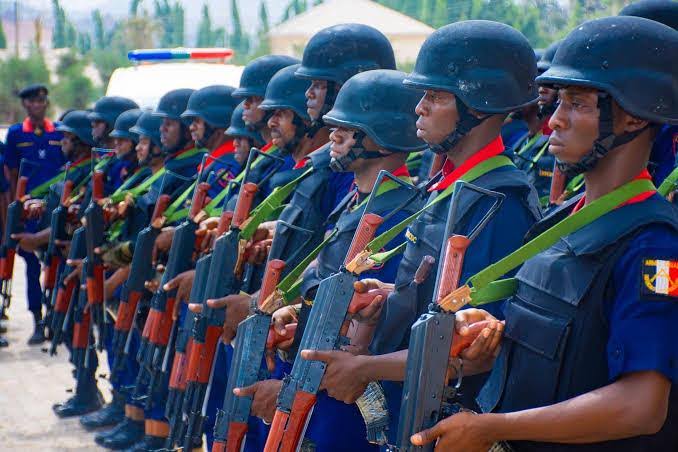
A promise of free education has allegedly become a deadly trap for 16 children from poor communities in Nasarawa State, with the Nigeria Security and Civil Defence Corps (NSCDC) uncovering a trafficking network that reportedly sold the minors for N2 million each.
The case exposes how poverty, parental vulnerability and false humanitarian promises can be exploited by criminal networks to turn children into commodities.
According to the NSCDC, the victims were lured from Kama Madaki and Gudindi Mada communities in Kokona Local Government Area of Nasarawa State by a man who allegedly posed as an official of the National Council of Child Rights Advocate, a civil society organisation.
The suspect reportedly operated under the guise of an NGO and orphanage initiative known as the “Back to School Project”, convincing less-privileged parents that their children would receive free education.
For parents struggling to provide basic necessities for their children, the offer appeared to provide hope. Instead, according to the NSCDC, it allegedly delivered their children into the hands of traffickers and buyers.
At a news briefing at the NSCDC Headquarters in Abuja on Friday, the Corps Public Relations Officer, Mr Babawale Afolabi, said the suspect deceived parents into releasing their children to him.
“Under the guise of operating an NGO and orphanage programme called the Back to School Project, he lured willing, less privileged parents into releasing their children with promises of free education,” Afolabi said.
The scale of the operation became clearer when investigators discovered that 16 children had been trafficked, with each allegedly sold for N2 million.
That translates to a potential N32 million trafficking operation if all 16 transactions were completed.
The intervention came through the Commandant General’s Special Intelligence Squad (CG’s SIS), headed by Commander Dandaura Appollos.
Rather than allowing the victims to disappear into the trafficking network, the intelligence team deployed what the NSCDC described as advanced field tracking, technical intelligence and coordinated operations across several states.
Afolabi said operatives eventually traced the buyers to different parts of the country.
“Through advanced field tracking, technical intelligence and multi-state tactical sweeps, operatives of the CG’s SIS tracked down the buyers who were from different locations in the country,” he said.
The operation resulted in the rescue of 15 of the 16 children.
Three victims were rescued separately in Anambra, Imo and Enugu states, while another 12 were recovered during a coordinated operation along eastern transit routes.
The geographical spread of the rescue operation underlines the organised nature of the network and the speed with which trafficked children can be moved away from their communities and into unfamiliar locations.
The NSCDC has so far arrested three suspected buyers — one male and two females — in connection with the case.
For the rescued children and their families, the operation represents a reprieve from what could have become a prolonged cycle of exploitation. For law enforcement authorities, however, the case raises broader questions about how easily traffickers can infiltrate vulnerable communities through seemingly legitimate humanitarian initiatives.
The alleged use of an education programme is particularly significant. Education is often presented to poor families as a pathway out of poverty, making promises of free schooling a powerful tool for gaining parental trust.
The case therefore highlights the need for parents and communities to verify organisations and individuals offering to take custody of children, particularly where promises of free education, accommodation or welfare are involved.
It also underscores the importance of stronger monitoring of organisations working with children and greater public awareness of the tactics used by traffickers.
For the NSCDC, the message is unequivocal.
Afolabi said the Corps maintained a zero-tolerance policy toward crime and human trafficking, adding that investigations were still ongoing.
He said all suspects found culpable would be prosecuted after the completion of the investigation.
But beyond the arrests and prosecutions lies a more troubling reality: in communities where poverty makes promises of free education irresistible, traffickers may find fertile ground.
The rescue of 15 children has closed one chapter of the case. The bigger challenge is ensuring that poverty, desperation and misplaced trust do not continue to provide traffickers with an open door into the lives of vulnerable Nigerian families.
