


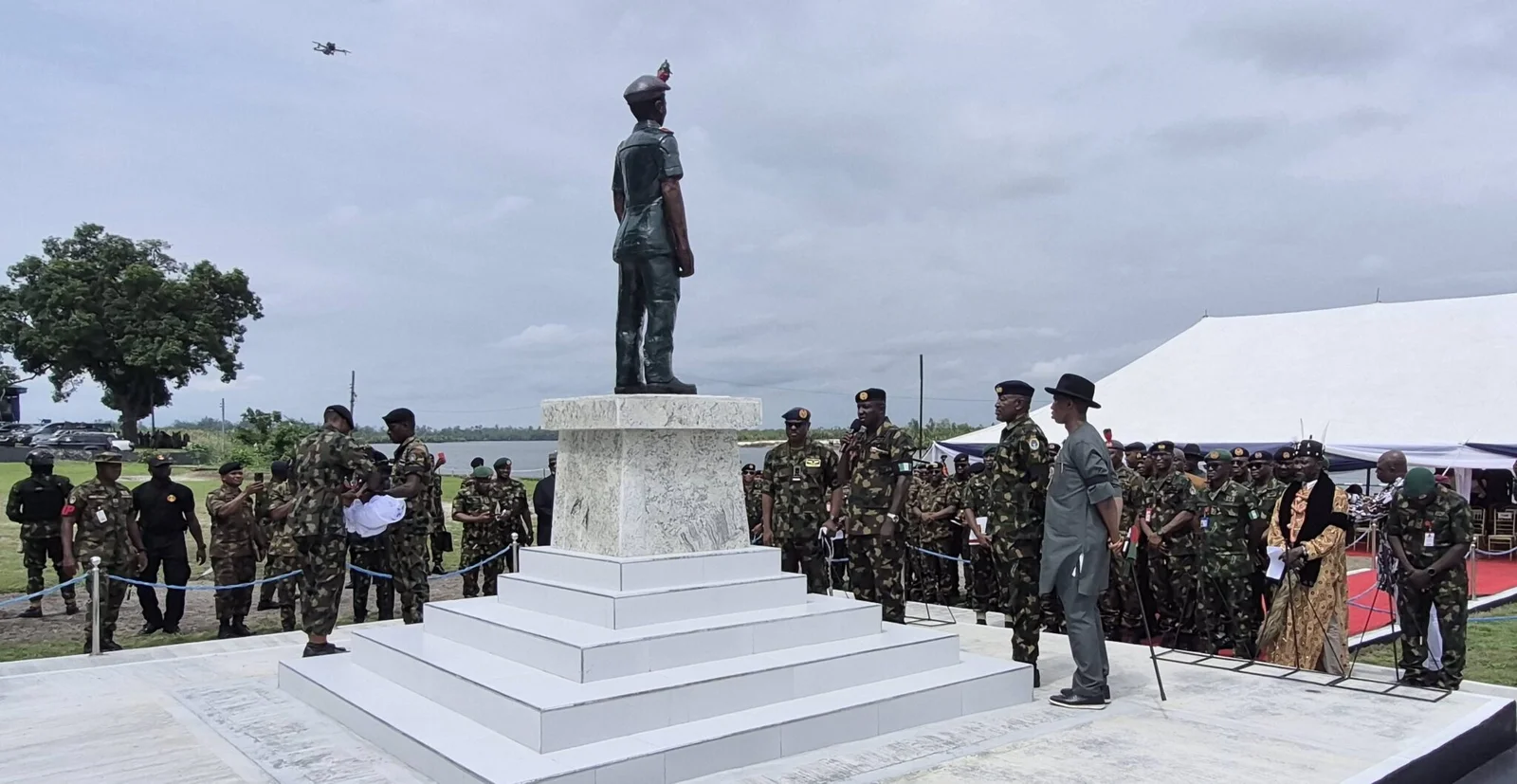
The Nigerian Navy on Sunday turned grief into permanence as it unveiled a cenotaph at the Nigerian Navy Basic Training School (NNBTS), Onne, Rivers State, in honour of 11 young Nigerian Defence Academy (NDA) cadets who died during training in 1990.
For many present, the ceremony was less about ceremony and more about closure—a long-awaited recognition of lives cut short in the line of preparation for service to the nation.
Presiding over the wreath-laying ceremony, Chief of Army Staff (COAS), Lt.-Gen. Waidi Shaibu, returned to a deeply personal chapter of military history. The fallen cadets were members of the 41 Regular Course of the NDA—the same course as Shaibu—making the moment both official and intimate.
The cadets lost their lives on July 23, 1990, during a routine boat handling exercise at what was then the Nigerian Naval College, Onne. Their boat collided with a stationary jetty and capsized, ending what were promising military careers before they truly began.
At the heart of the memorial was a message Shaibu said the nation must never lose sight of.
“We gather not merely to commission a monument but to consecrate a sacred place of remembrance for our beloved course mates,” he said.
He described the cenotaph as more than stone and inscription, calling it a permanent reminder of sacrifice, discipline and the fragility of military training.
“On that fateful day, 11 promising officers in the making lost their lives. It remains one of the saddest chapters in the history of military training in Nigeria,” he said.
Shaibu stressed that although the cadets did not fall in combat, their deaths were still a form of national service, occurring in the course of preparing to defend Nigeria.
“Their sacrifice is no less profound, and their memory deserves to be preserved and honoured for generations to come,” he said.
The ceremony transformed the training ground into a place of reflection, where colleagues, officers and families revisited a shared loss that has endured for 35 years.
Shaibu also extended condolences to the families of the deceased, assuring them that their loved ones’ names remain part of Nigeria’s military memory.
The event also drew remarks from the Chief of Naval Staff, Vice Adm. Idi Abbas, who described the cenotaph as a necessary and overdue recognition of the cadets’ sacrifice. He was represented by the Chief of Administration at Naval Headquarters, Rear Adm. Jonathan Mamman.
Abbas said the memorial sends a clear message that the Navy has not forgotten those who died in training and continues to learn from past tragedies.
“Their names and devotion will forever remain part of the proud heritage of the service and an inspiration to future generations of officers, ratings and cadets,” he said.
He noted that the 1990 tragedy prompted deeper reforms in naval training, particularly in safety protocols and supervision.
“Training doctrines and standard operating procedures are being continuously reviewed to align with international best practices.
“Greater emphasis is now placed on comprehensive risk assessment, enhanced supervision, improved emergency response capability, and the use of modern training aids and simulation technology,” he said.
He added that ongoing investments in instructor development, trainee welfare, medical support and psychological resilience are aimed at producing officers who are not only capable, but also mentally and physically prepared for service.
At Onne, however, the focus was not on reforms or strategy, but on remembrance. The cenotaph now stands as a silent witness to a training accident that changed lives and reshaped procedures.
For those who knew the 11 cadets, Sunday’s unveiling was a long-overdue acknowledgment that their names—and their loss—remain part of Nigeria’s naval story.
