


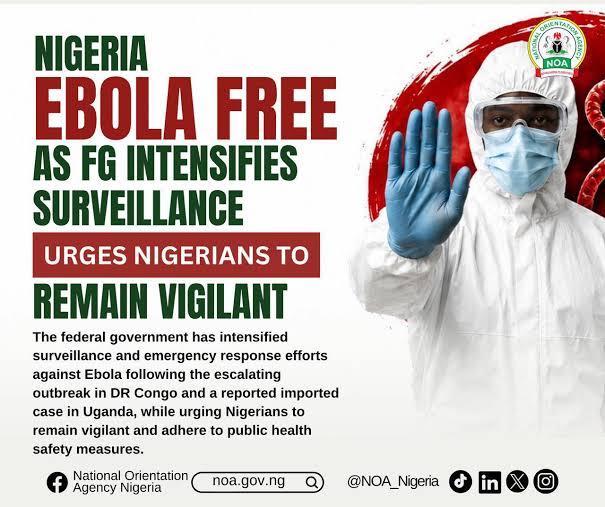
The Federal Government has strengthened health screening and surveillance at Nigeria’s land borders, airports, and seaports following renewed outbreaks of Ebola virus disease in parts of Central Africa.
The move comes amid growing concern over reported cases in the Democratic Republic of the Congo and Uganda, where health authorities and the World Health Organization (WHO) have confirmed ongoing transmission of the Bundibugyo strain of the disease.
According to data cited by the WHO, the Democratic Republic of the Congo has recorded about 321 confirmed cases, including 48 deaths, while Uganda has reported nine confirmed cases with one fatality. Although the global health body recently adjusted suspected case figures downward from over 900 to 116 following verification, confirmed infections continue to raise regional concern.
In a statement issued by the Federal Ministry of Health and Social Welfare, Nigeria said no confirmed case of Ebola virus disease has been detected in the country. However, it noted that preparedness measures have been activated nationwide to prevent any potential importation.
The ministry said travellers arriving Nigeria who are identified as high-risk or who show symptoms consistent with viral haemorrhagic fevers will undergo secondary screening, isolation where necessary, and referral for further assessment.
Enhanced screening measures now in place at points of entry include mandatory temperature checks using infrared scanners and thermometers, completion of health declaration forms, travel history reviews, and intensified risk profiling of incoming passengers.
The government also confirmed that surveillance systems under the Integrated Disease Surveillance and Response framework have been reinforced nationwide, alongside community-based monitoring and real-time public health alert tracking.
Public Health Emergency Operations Centres have been activated, while Rapid Response Teams at national and sub-national levels have been placed on standby to respond swiftly to any suspected case.
Health facilities across the country have been directed to strengthen infection prevention and control practices, improve triage systems, and ensure prompt reporting of suspected cases of Ebola virus disease and other viral haemorrhagic fevers.
The ministry urged Nigerians not to panic, stressing that the measures are preventive and designed to ensure early detection and containment if needed.
It also advised the public to maintain proper hygiene, avoid contact with bodily fluids of sick individuals, refrain from handling bushmeat from unknown sources, and promptly report unusual illnesses or deaths to health authorities.
The Ebola outbreak was declared on May 15 in the conflict-affected Ituri Province of the Democratic Republic of the Congo, prompting renewed regional surveillance and border health coordination across affected countries.
