


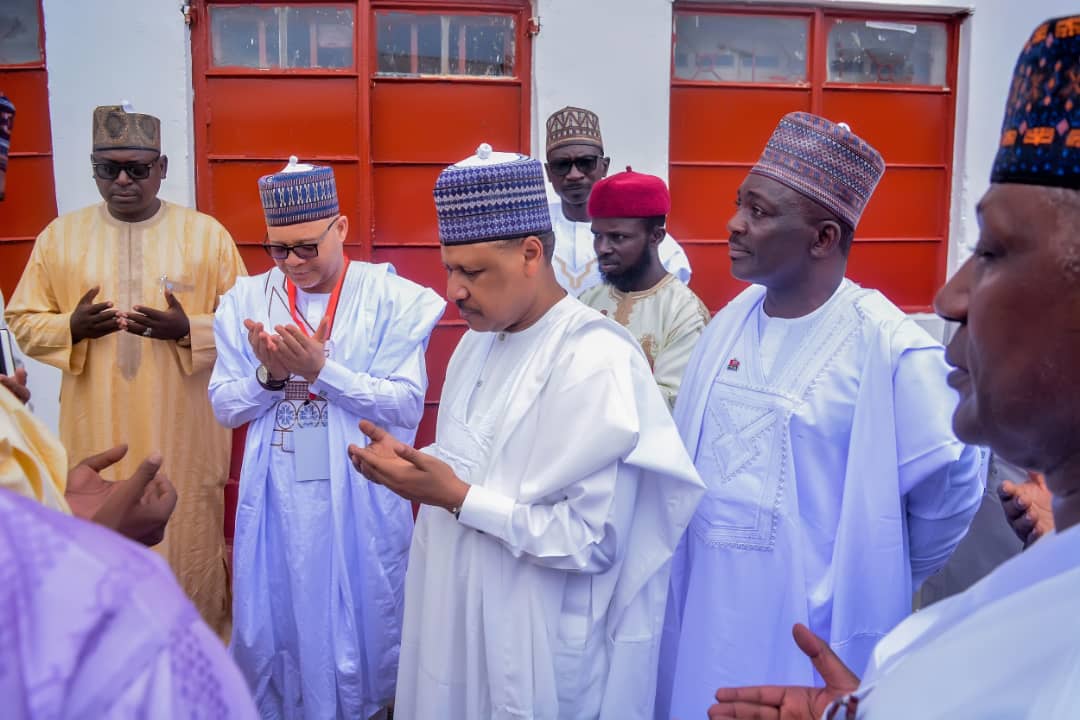
At Kaduna AGM and inaugural Bashir Chedi Annual Lecture, Institute calls for intergenerational knowledge transfer, celebrates professional excellence and rallies members for WPRF Abuja 2026
The Nigerian Institute of Public Relations (NIPR) has used the Annual General Meeting of its Kaduna State Chapter and the inaugural Bashir Chedi Annual Lecture to make a powerful case for mentorship, institutional memory and the deliberate transfer of professional knowledge from one generation to another.
The event, which brought together senior practitioners, young professionals, government representatives, academics and members of the late Bashir Chedi’s family, also provided an opportunity for the Institute to celebrate professional leadership, recognise the importance of strategic government communication and mobilise practitioners for the forthcoming World Public Relations Forum, Abuja 2026.
The Vice President of NIPR, Professor Emmanuel Samu Dandaura, represented the President and Chairman of Council, Dr Ike Neliaku, and delivered his remarks on behalf of the Institute’s leadership.
The Special Guest of Honour, the Honourable Minister of Information and National Orientation, Alhaji Mohammed Idris, FNIPR, brought a strong national dimension to the gathering, underscoring the growing importance of professional public relations and strategic communication to governance and national development.
A Gathering That Looked Back and Forward
In his address delivered on behalf of the NIPR President, Professor Dandaura said the Kaduna gathering was unusual because it combined the institutional business of an Annual General Meeting with the deeply human responsibility of remembering a colleague who had contributed significantly to the Institute.
“There are occasions when an organisation gathers simply to conduct its business,” the President’s address stated. “There are others when it gathers to remember. And there are rare occasions when it does both, looking back with gratitude while looking forward with renewed purpose.”
The occasion, he said, was precisely one of those rare moments.
While the Kaduna Chapter was conducting its AGM, it was simultaneously launching the Bashir Chedi Annual Lecture, creating what the Institute leadership described as a particularly fitting way of ensuring that the memory of a respected practitioner continues to contribute to the intellectual life of public relations.
Remembering Bashir Chedi Through Ideas
Bashir Chedi was remembered not merely for the positions he occupied within NIPR, but for the quality of leadership he brought to the Institute.
A former member of the NIPR Governing Council, Chedi was described as a colleague, brother and committed professional whose consultative approach left a lasting impression on the Institute.
His most distinctive quality, according to the address, was his willingness to listen.
“Bashir understood that leadership is not always about having the loudest voice in the room,” the address noted. “Sometimes, leadership is about listening.”
It was also about bringing people together, allowing different perspectives to emerge and helping institutions arrive at decisions that stakeholders could collectively own.
That quality, the Institute leadership noted, made Chedi’s contribution to NIPR much greater than the positions he held or the formal decisions in which he participated.
His legacy was also found in the conversations he helped create.
For that reason, the Institute considered a lecture series an especially appropriate way to immortalise him.
A lecture creates a continuing intellectual space. It allows ideas to outlive their originators, encourages debate and gives subsequent generations an opportunity to engage with the issues that shaped the profession.
The President’s address expressed appreciation to Chedi’s family for sharing him with the profession and acknowledged that no professional honour could substitute for the loss of a husband, father, brother or friend.
The Institute, however, hoped the occasion would reassure the family that his contribution had not been forgotten.
His name, the address affirmed, would continue to live not only in NIPR’s records but in the intellectual life of the profession he served.
Mentorship: The Baton Must Be Passed
The focus of the keynote and panel discussion on intergenerational communication and mentorship gave the event a particularly contemporary relevance.
The NIPR President linked the subject to the wider continental conversation around the professionalisation of public relations and responsible communication in Africa.
He recalled his recent engagement in South Africa with the Public Relations Institute of Southern Africa (PRISA), where mentorship emerged as an important component of building a sustainable professional future.
Significantly, Nigerian initiatives such as the Institute’s Professional Standards Guide and Young Professionals Hub attracted interest from colleagues in South Africa.
For NIPR, this was evidence that Nigerian practitioners are not merely participants in the continental professional conversation. They are increasingly contributing ideas and structures from which others can learn.
“Sometimes we do not appreciate what we are building until people outside Nigeria begin to ask us how we are doing it,” the President observed.
Yet the Institute’s message was that professional development must go beyond programmes, policies and institutional structures.
“Mentorship is not simply a programme,” the address declared. “It is a responsibility.”
It is the experienced practitioner opening the door to the younger professional and saying, in effect: come, sit beside me, watch, learn, and when your time comes, do it better.
That, NIPR argued, is how professions renew themselves.
It is how institutional memory is preserved, and also how the values and wisdom of one generation can be transferred before they disappear with retirement, disengagement or death.
The Institute therefore saw mentorship as one of the most meaningful ways of honouring Bashir Chedi’s memory.
A Light-hearted Moment With a Serious Message
The subject of mentorship acquired an unexpected and memorable dimension during the event when attention turned to the relationship between the Honourable Minister of Information and National Orientation and the young professionals he has mentored.
The President’s address commended the Minister’s mentees for publicly celebrating the progress they had made through the relationship, describing such appreciation as an example worth encouraging within the profession.
The Vice President, Professor Dandaura, also shared a light-hearted moment involving the Minister.
Recalling his remarks from the previous day about Alhaji Mohammed Idris’s contribution as a strategic reputation manager of the nation, Dandaura noted that the Minister’s performance had strengthened the argument for retaining experienced Fellows of NIPR at the highest levels of national communication management.
When the Minister arrived at the event wearing a white agbada, Dandaura, who was also dressed in white, joked that it was a coincidence that they appeared to be “supporting” him in white.
The moment became more symbolic when the master of ceremonies asked participants to “stretch your hand and grab somebody to show the way” as a practical illustration of mentorship.
The Minister stretched his hand towards Dandaura, who promptly grabbed it.
The Minister explained that he was merely responding to the MC’s instruction.
Dandaura, however, turned the moment into an entertaining affirmation of the importance of mentorship.
“To the mentees of the Minister, that is not a coincidence,” he declared. “He has anointed his next lead mentee.”
Turning to the Minister, he added: “Honourable Minister, thank you for the offer, and I hereby confirm that I have assumed that role from today.”
The laughter that followed did not obscure the deeper point.
Mentorship is ultimately about relationships. It is about access, example, encouragement and the willingness of experienced professionals to make room for those coming behind them.
Celebrate Excellence While the Heroes Are Still Here
The Kaduna event also reinforced another emerging principle of NIPR’s leadership: professionals should be celebrated while they are alive and able to hear the applause.
The Institute’s leadership disclosed that the immediate mentees of the Minister had expressed their desire to celebrate him while he could witness and appreciate the recognition.
NIPR Council, the address noted, shares that philosophy.
“We must not wait until our heroes are gone before we celebrate them,” the President said.
The Institute began advancing this culture during its Diamond Anniversary celebrations and is now taking it further.
On 7 December 2026, NIPR plans to launch the NIPR Prize Award initiative, designed to recognise outstanding contributions to public relations and communication.
The objective is to create a professional culture in which excellence is identified and celebrated in real time rather than becoming the subject of posthumous tributes.
“We want to build a culture where our heroes are identified, honoured and celebrated while they are still with us,” the President stated.
The philosophy was summed up in one striking observation:
“A profession that only remembers its heroes after they are gone is remembering too late.”
Minister’s Presence Signals Growing Importance of Communication in Governance
The presence of the Honourable Minister of Information and National Orientation as Special Guest of Honour was a major highlight of the event.
Welcoming Alhaji Mohammed Idris, FNIPR, the Institute’s leadership described his presence as significant, particularly because of his responsibility for the nation’s information and national orientation architecture.
The address acknowledged the Minister’s emphasis on coordinated government communication, ministerial press briefings, citizen engagement and efforts to rebuild confidence in official information.
The National Values Charter was also highlighted as an important platform for connecting communication with national orientation and citizenship.
The establishment in Abuja of the UNESCO Category 2 International Media and Information Literacy Institute was similarly identified as a significant investment in helping citizens navigate an increasingly complex information environment.
The underlying message was clear: governance in the contemporary information environment requires more than policy formulation.
Government must be able to explain its policies, engage citizens around them and build the trust necessary for those policies to succeed.
For NIPR, this reinforces the strategic importance of professional public relations and creates further opportunities for collaboration between the Institute and government.
Kaduna Chapter Challenged to Build on Its Gains
The NIPR leadership also commended the Kaduna Chapter for its commitment to the national Institute.
The Chapter had recently hosted NIPR Week and the Institute’s Annual General Meeting, a responsibility that demanded significant organisation, sacrifice, resources and commitment.
The outgoing leadership was commended for successfully delivering on that responsibility.
The incoming leadership, however, was reminded that leadership is ultimately measured not only by what it achieves but by what it leaves behind.
The charge was simple: consolidate the gains and take Kaduna higher.
This includes strengthening professional development, bringing more young practitioners into the life of the Institute, deepening relationships with government, business and academia, and positioning Kaduna as an even stronger centre of professional excellence within NIPR.
WPRF Abuja 2026: Nigeria’s Moment on the Global Stage
As the event moved towards its conclusion, attention turned to one of the biggest opportunities before Nigerian public relations practitioners: the hosting of the World Public Relations Forum, Abuja 2026.
The Institute’s leadership stressed that the global forum should not be viewed merely as another professional conference.
It represents an opportunity for Nigeria to tell its story to the world and for Nigerian practitioners to demonstrate the depth, professionalism and intellectual capacity of the country’s public relations community.
It is also an opportunity for Nigeria and Africa to influence the global conversation about the future of public relations.
Members of the Kaduna Chapter were therefore urged to register, participate and encourage their colleagues to attend.
“Do not allow WPRF Abuja 2026 to be something you hear about afterwards,” the address urged. “Be part of it.”
The message was deliberately direct: this is a defining moment not only for NIPR but for the Nigerian communication profession.
Building a Profession That Will Outlive Its Builders
The Kaduna AGM and Bashir Chedi Annual Lecture ultimately became a story about continuity.
It was about the responsibility to remember those who came before, recognise those who are making a difference today and deliberately prepare those who will take the profession forward tomorrow.
Bashir Chedi was remembered because he mattered.
The annual lecture was established because his example should continue to matter.
Mentorship was elevated because the next generation must inherit more than titles and positions. It must inherit wisdom, values, experience and institutional memory.
Living heroes must be celebrated because recognition should not always come after death.
Kaduna was challenged because strong institutions are built by people who accept responsibility and leave behind something stronger than they inherited.
WPRF Abuja 2026 was placed before practitioners because the future of public relations will not simply happen. It must be deliberately built.
That was the thread connecting the various strands of the Kaduna gathering: memory must become a bridge to the future.
If Bashir Chedi were present, the Institute’s leadership suggested, he might well remind practitioners of the value of listening, consultation and collective responsibility.
The appropriate response, therefore, is not simply to remember him.
It is to practise what he represented. To listen better, to mentor better, to celebrate better, and to build institutions that will outlive those who currently occupy their offices.
In Kaduna, NIPR did more than inaugurate a lecture in memory of one of its own.
It renewed a professional covenant between generations.
The past was honoured. The present was recognised. The future was challenged.
The message was unmistakable: the strongest legacy a professional can leave is not merely the office held, but the people equipped to carry the work forward.
