

NSCI: Nigeria’s Bid to Become Africa’s Cloud, AI and Digital Infrastructure Hub
“We need to build the required infrastructure to harness the potential of Nigeria’s digital sector for sustainable economic growth and development.” – Kashifu Inuwa Abdullahi, DG NITDA

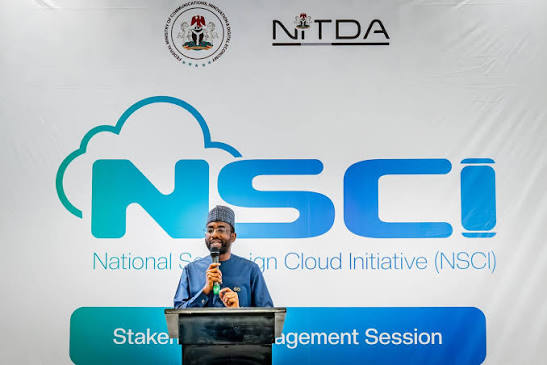
Nigeria is positioning itself to become a leading African hub for cloud computing, artificial intelligence and digital infrastructure through the National Sovereign Cloud Initiative (NSCI), which brings together policy, regulation, infrastructure assurance, investment mobilisation and institutional coordination. It links the National Digital Cloud Policy, National Cloud Computing Guidelines and National Digital Infrastructure Assurance Framework (NDIAF), developed by the National Information Technology Development Agency (NITDA).
The strategy recognises cloud computing as critical economic infrastructure for AI, fintech, digital government, manufacturing and cross-border commerce. Its infrastructure proposition therefore extends beyond conventional cloud capacity to include data centres, fibre connectivity, cybersecurity, digital skills and high-performance AI compute, including scalable GPU capacity.
The NSCI is primarily an investment-enabling and market-development agenda, not a Government infrastructure-procurement programme. Government is expected to provide the policy, regulatory, assurance, demand and investment environment needed to catalyse private capital and competitive infrastructure development. The National Digital Cloud Policy targets $250 million in private investment within 12 months and $750 million within 24 months, while positioning Nigeria as a hosting and processing hub for West Africa and the wider African market.
Digital sovereignty does not mean blanket data localisation. Instead, workload and data classification determine applicable hosting, sovereignty, security and assurance requirements. Sensitive government and regulated workloads may attract stronger sovereignty requirements, while permitted cross-border data flows and international cloud partnerships can continue. The risk-based approach seeks to balance national resilience and control with interoperability and access to global technology.
Sustainable demand is equally important. Government’s substantial ICT and cloud expenditure can provide a predictable market signal if cloud-appropriate spending is better coordinated, existing infrastructure is better utilised and adoption matches workload requirements. To address this, NITDA and the Budget Office of the Federation have established the NSCI Joint Technical Committee, examining ICT and cloud expenditure, total cost of ownership, infrastructure utilisation, procurement alignment, financing and investment mobilisation.
Connectivity is another critical pillar. Project BRIDGE, led by the Federal Ministry of Communications, Innovation and Digital Economy, is structured as a public-private partnership targeting at least 90,000 kilometres of fibre across Nigeria, covering all 36 states and the FCT and connecting 774 local governments. Estimated at about $2 billion, its financing commitments include $500 million from the World Bank, $200 million from the African Development Bank and $100 million from the European Bank for Reconstruction and Development, with further private-sector participation expected. Reliable, resilient and competitively priced power is equally vital because data centres and AI-compute facilities are highly energy-intensive.
Private investment is already expanding computing capacity. In Lagos, Kasi Cloud has commissioned the first phase of its Lekki campus, while the wider campus is designed to reach about 100MW of critical IT capacity at full development. The 100MW figure therefore represents planned full-development capacity, not current operational capacity. Such investments signal growing interest in Nigeria as a location for hyperscale, cloud and AI workloads, while NDIAF and other cloud instruments provide technical assurance and predictable security and provider requirements.
The continental opportunity is reinforced by the African Continental Free Trade Area (AfCFTA) Digital Trade Protocol, which seeks stronger cross-border digital commerce, interoperability and trusted digital systems. Nigeria’s opportunity extends beyond attracting global technology companies to enabling Nigerian cloud, cybersecurity, software and digital-service providers to scale across Africa — advancing a “Build Local, Grow Global” digital economy.
With its large domestic market, subsea connectivity, expanding fibre network, technology talent, data-centre growth and emerging AI-compute capacity, Nigeria could become a major exporter of cloud, AI, cybersecurity, data-processing and other digital services. But achieving this requires coordinated implementation. The Sovereign Cloud Governance Committee, wider multi-agency architecture and NSCI JTC underscore the need for coordination across technology, procurement, finance, investment, power, connectivity, cybersecurity and data governance.
The NSCI therefore goes beyond protecting Nigerian data; it seeks to build the infrastructure, markets and institutional confidence needed for a larger African digital economy. In the physical economy, roads, railways and ports connect markets; in the digital economy, fibre, data centres, cloud platforms and AI compute can connect a continent.
Ultimately, success will depend on execution — mobilising private investment, creating sustainable demand, improving power and connectivity, developing skills, expanding compute capacity and consistently implementing the regulatory and assurance framework. If these elements come together, Nigeria could move from being one of Africa’s largest digital markets to becoming one of the continent’s leading cloud, AI and digital-infrastructure hubs.
