


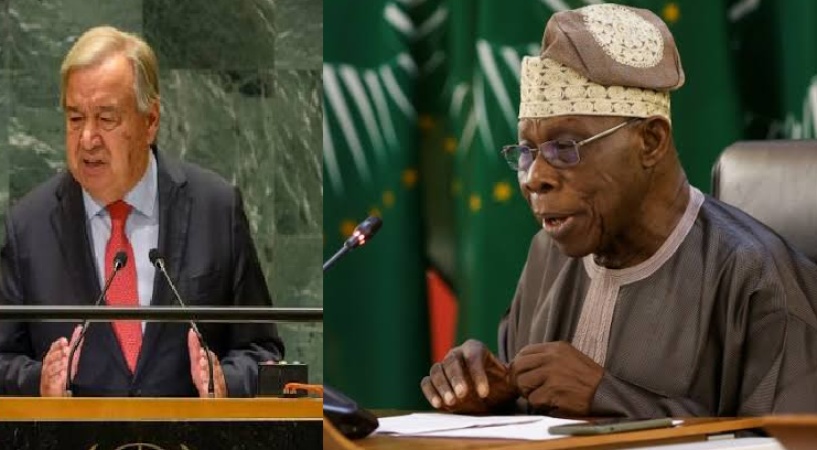
As renewed fighting in northern Ethiopia threatens to plunge the country into another devastating conflict, the United Nations has thrown its weight behind former Nigerian President Olusegun Obasanjo’s diplomatic efforts to salvage a fragile peace agreement and prevent a fresh humanitarian catastrophe.
UN Secretary-General António Guterres has endorsed the African Union-led mediation spearheaded by Obasanjo, urging Ethiopia’s warring parties to abandon military confrontation and return to negotiations under the November 2022 Pretoria peace agreement.
The renewed international push for peace comes amid a rapidly deteriorating security situation in the Tigray region, where intensified fighting, the seizure of key airports and reports of hostilities spreading into neighbouring areas have heightened fears of a wider conflict.
For Obasanjo, the latest crisis represents another critical test of the peace process he helped broker after two years of devastating warfare between Ethiopia’s Federal Government and the Tigray People’s Liberation Front (TPLF).
In a statement issued through his spokesperson, Stéphane Dujarric, Guterres expressed grave concern over the escalation, particularly reports that airports in Mekelle, Axum and Shire had been seized.
The UN chief warned that further military action could plunge Ethiopia into “a broader and more devastating conflict,” calling on all parties to exercise maximum restraint, immediately de-escalate tensions and protect civilians.
His endorsement of the African Union’s diplomatic intervention underscores growing international concern that the fragile peace achieved in Pretoria could unravel, reopening deep-seated political and security divisions in Africa’s second-most populous country.
Guterres urged the parties to return to negotiations in good faith within the framework of the Pretoria Agreement, stressing the need to preserve the gains made through dialogue and prevent a further deterioration of the humanitarian situation.
The African Union has also intensified its diplomatic engagement, calling for an immediate halt to the escalation and renewed direct talks between the parties.
AU Commission Chairperson Mahmoud Ali Youssouf has directed Obasanjo, the organisation’s High Representative for the Horn of Africa, to urgently re-engage the parties in a bid to reduce tensions and safeguard the peace process.
The renewed assignment places the former Nigerian leader at the centre of another high-stakes diplomatic effort to prevent Ethiopia from sliding back into widespread hostilities.
Obasanjo led the AU mediation team that brokered the Agreement for Lasting Peace through a Permanent Cessation of Hostilities in Pretoria, South Africa, on November 2, 2022.
The negotiations were facilitated alongside former Kenyan President Uhuru Kenyatta and former South African Deputy President Phumzile Mlambo-Ngcuka.
The agreement brought an end to two years of devastating conflict that claimed lives, displaced communities and disrupted essential services across Tigray.
It established a framework for the cessation of hostilities, humanitarian access, restoration of essential services, disarmament, reconciliation and political dialogue.
However, the latest escalation has exposed the fragility of the peace process, with renewed military confrontations raising concerns about the sustainability of the agreement.
The reported seizure and occupation of the airports in Mekelle, Axum and Shire by Tigrayan forces, alongside the detention of federal personnel, have emerged as major flashpoints in the unfolding crisis.
The developments have heightened fears that a dispute increasingly characterised by military manoeuvres could expand beyond Tigray, undermining efforts to consolidate peace and stability across Ethiopia.
Beyond the political and military implications, the renewed fighting has raised fresh concerns about the safety of civilians and the possibility of further disruption to humanitarian operations.
The UN Human Rights Office has also expressed alarm over the impact of the renewed hostilities on civilians, calling for immediate de-escalation and measures to prevent further suffering.
For the international community, the immediate priority is to prevent the crisis from escalating into another prolonged conflict with devastating consequences for millions of people.
Guterres has therefore called on the parties to prioritise civilian protection, ensure humanitarian access and return to meaningful negotiations rather than allow military confrontation to destroy the gains of the Pretoria peace process.
As Obasanjo prepares to re-engage the parties under the African Union’s renewed diplomatic initiative, the future of Ethiopia’s fragile peace agreement hangs in the balance.
The coming days could prove decisive in determining whether dialogue can once again prevail over military confrontation or whether the country will be drawn into another cycle of violence.
For Obasanjo and the African Union, the challenge is not merely to halt the latest escalation but to preserve a peace agreement whose survival remains critical to Ethiopia’s stability and the wider Horn of Africa.
