


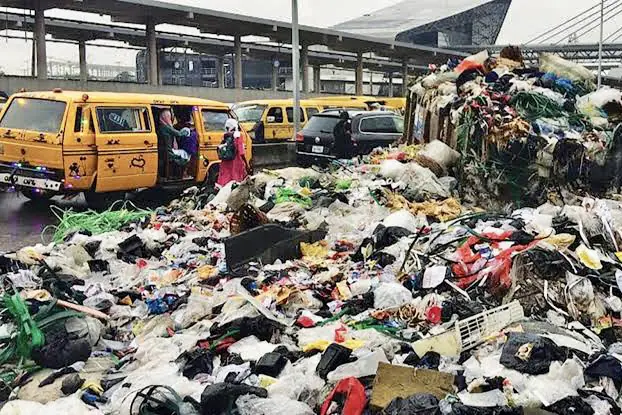
For a city of more than 20 million people, waste management is not merely an environmental issue; it is a test of governance, infrastructure and public discipline.
That reality has come sharply into focus in Lagos, where Governor Babajide Sanwo-Olu has declared what he called a “small state of emergency” on waste management following mounting pressure on refuse collection and disposal across the state.
The declaration came after the governor inspected the sprawling Olusosun dumpsite in Ojota, accompanied by his deputy, Dr Obafemi Hamzat, and Commissioner for Environment and Water Resources, Tokunbo Wahab.
What the inspection revealed was a waste-management system under pressure, with the consequences increasingly visible on the streets. In recent weeks, refuse has accumulated in different parts of the metropolis, raising concerns over sanitation, public health and the overall appearance of Nigeria’s commercial capital.
Sanwo-Olu acknowledged the urgency, saying the government needed to understand the problems at the operational level before deploying immediate, medium- and long-term interventions.
“We can clearly declare what we will call a small state of emergency,” the governor said, stressing that the objective was to restore effective waste collection and disposal across Lagos.
A system under pressure
At the centre of the crisis is the capacity of the state’s disposal infrastructure.
Olusosun, one of Lagos’ major waste reception points, currently handles between 250 and 350 trucks daily. The government now wants to increase that capacity to between 350 and 450 trucks a day.
One of the immediate strategies is to increase the number of tipping points at the dumpsite from the current two or three to about four or five. The logic is straightforward: the faster trucks can discharge their loads, the faster they can return to the streets to collect more waste.
The problem is particularly significant because delays at disposal sites have a cascading effect. When collection trucks spend several hours waiting to discharge, fewer vehicles are available to collect refuse from households and roads. The result is a growing backlog that eventually spills onto the streets.
Sanwo-Olu said the government wants to prevent a situation where trucks spend 12 hours or even an entire day waiting to discharge.
The state is therefore planning similar interventions at Solu 3, Iwulepe in Ikorodu and Oke-Osho in Epe, while Erikitte in Badagry is also being developed.
The governor expressed hope that within six weeks, four active dumpsites would be operating, with a fifth expected at Erikitte.
Beyond dumping: Lagos looks to transfer stations
But Lagos’ waste challenge cannot be solved simply by creating more places to dump refuse.
The state’s medium- and long-term strategy is increasingly focused on transfer stations, material recovery and waste conversion.
According to Sanwo-Olu, two 2,400-metric-tonne transfer loading stations are being developed at Olusosun and Solu 3. The facilities are expected to receive compacted waste before it is moved to material recovery facilities under development at Oke-Osho in Epe and Erikitte in Badagry.
The planned system represents a shift from simply collecting and disposing of waste towards treating refuse as a resource that can be sorted, recovered and converted into useful materials.
The governor said the two transfer stations should be capable of receiving about 500 trucks daily, while the material recovery facilities will provide additional capacity for sorting and conversion.
These are significant investments, which Sanwo-Olu described as involving tens of millions of dollars.
Yet, the success of the strategy will ultimately depend not only on the construction of infrastructure but also on how efficiently the entire chain—from household collection to transportation, transfer, sorting, recovery and final disposal—is managed.
The truck shortage
Another pressure point is the availability of collection vehicles.
The Lagos State Government has announced plans to procure 160 new compactor trucks, while Zoomlion, one of the operators involved in the system, is expected to procure additional vehicles.
The government will also acquire landfill compactors to improve operations at disposal sites.
More trucks should translate into improved collection, but the intervention also highlights a deeper issue: waste management in a megacity requires continuous investment in equipment, maintenance and logistics.
Without sufficient and functional vehicles, even an efficient disposal network will struggle to keep pace with the volume of waste generated daily.
The PSP question
Perhaps one of the most consequential elements of the governor’s intervention is the planned review of Private Sector Participants (PSPs).
The PSP system has for years been central to waste collection in Lagos. But the governor said the system needs to be cleaned up, arguing that the state should not have hundreds of operators without the capacity to deliver reliable services.
“We do not want to have 800 PSPs when only 400 are effective,” he said.
The proposed review will seek to identify operators with the technical and financial capacity to remain in the system, while creating room for stronger investors.
This could bring efficiency into the sector, but it also raises the need for transparent criteria. If ineffective operators are removed, the state must ensure that their service areas do not become abandoned spaces where refuse accumulates.
The operators have also committed to procuring additional compactor trucks, while the government says it is prepared to explore financing models that could reduce investment risks and prevent financially distressed operators from collapsing.
Residents have a role to play
Government infrastructure and private-sector efficiency, however, represent only one side of the equation.
Sanwo-Olu has also placed responsibility on residents, particularly on the issue of payment for waste collection.
The governor argued that it was unfair for service providers to continue rendering services when residents fail to pay.
“Lagosians, in particular, want service, but we do not want to pay for the service,” he said, insisting that the situation must change.
The argument exposes one of the fundamental challenges in public-service delivery: the relationship between service quality and willingness to pay.
Residents are more likely to pay when collection is regular, predictable and efficient. At the same time, waste operators need revenue to maintain trucks, employ personnel and sustain operations.
Breaking that cycle will require accountability on both sides—operators must deliver the services for which they charge, while residents must meet their obligations.
A warning beyond sanitation
Lagos’ latest waste crisis is ultimately about more than piles of refuse on the streets.
It is a warning about the difficulty of managing a rapidly growing megacity with enormous consumption, expanding residential areas and increasingly complex waste streams.
The governor’s declaration of a “small state of emergency” signals recognition that temporary measures alone will not be enough.
The immediate priority is to get trucks moving and clear accumulated refuse. The medium-term challenge is to expand disposal capacity and improve the efficiency of private operators. The long-term ambition is to build a system where waste is increasingly transferred, sorted, recovered and converted rather than simply dumped.
The test for Lagos will be whether these three layers of intervention can work together.
If the additional trucks arrive, disposal bottlenecks are eliminated, PSP operators become more efficient and residents meet their payment obligations, the current crisis could become the catalyst for a more sustainable waste-management system.
But if infrastructure expansion is not matched by effective coordination, enforcement, investment and public participation, the “small state of emergency” could become another temporary response to a problem that keeps returning.
For Lagos, the stakes are high. In a city where every traffic jam, blocked drainage channel and overflowing waste point can quickly affect millions of people, keeping the streets clean is not simply about aesthetics. It is an essential part of keeping the megacity functioning.
